From the jump, Masahiro Tanaka’s modus operandi has been blurring the lower border of the strike zone. Tanaka’s weapon of choice, his splitter, has paved the way to considerable Rookie of the Year votes, two all-star appearances, and a vital spot in the rotation of baseball’s perennial contender.
However, Tanaka’s ability to miss bats hasn’t remained consistent. He’s faltered to the depths of a 4.74 ERA in 2017 and an ugly summer last season, in which he put up ERAs of 5.08 and 8.77 in June and July. High-variance play isn’t particularly uncommon among pitchers at baseball’s highest level, but investigating the reasons for one’s struggles is always insightful.
An infinite amount of variables attributed to Tanaka’s play throughout his career. One sticks out as paramount. Tanaka’s splitter significantly correlates to his success on the mound.
A quick debriefing
We start with the following chart (and corresponding table) that begins to show this correlation. While Tanaka’s tERA appears to be less reliant on his splitter’s effectiveness (wSF/C), there’s still a clear trend between this pitch value and its impact on other pitching metrics.

| Year | wSF/C | FIP | ERA | tERA |
| 2014 | 2.4 | 3.04 | 2.77 | 3.8 |
| 2015 | 1.42 | 3.98 | 3.51 | 4.21 |
| 2016 | 2.1 | 3.51 | 3.07 | 3.92 |
| 2017 | 1.08 | 4.34 | 4.74 | 4.29 |
| 2018 | 0.85 | 4.01 | 3.75 | 4.21 |
| 2019 | -0.83 | 4.27 | 4.45 | 4.39 |
Furthermore, a myriad of statistics show how Tanaka’s highest highs and lowest lows may be explained by his splitter. In his best season, 2014, not only was his wSF/C at its best, but so was his K/9, SIERA, and xFIP. As seen in the chart, his FIP, ERA, and tERA share this similarity. For all of those marks besides ERA, 2019 represented career lows.
Mathematically speaking, there is strong evidence to support this claim as well. Initially, I thought to find the correlation between an encompassing statistic and his wSF/C. Without a singular statistic to summarize pitchers, I averaged the correlation of Tanaka’s FIP, xFIP, tERA, ERA, and SIERA with each of his weighted pitch values. His pitch values, ranked from most to least correlative to his success, came out to his Splitter (-0.816), Sinker (-0.622), Cutter (-0.428), Slider (-0.128), Curveball (0.322), and Fastball (0.64). As most pitching metrics are better when closer to zero, and pitch values are better when greater, a negative correlation is in fact what we are looking for.
A summer to forget, a fall to remember
Tanaka’s 2019 was objectively bad. Unsurprisingly, his splitter was no different. That particular pitch saw an insane drop in strikeout percentage, from 32.1% in 2018 to 12.7% last season. Opponents hit 51 points better against it than in 2018, a dramatic jump in batting average from .225 to .276. These numbers are subsequent of career highs in zone percentage and contact percentage, along with a career-low swinging strike percentage.
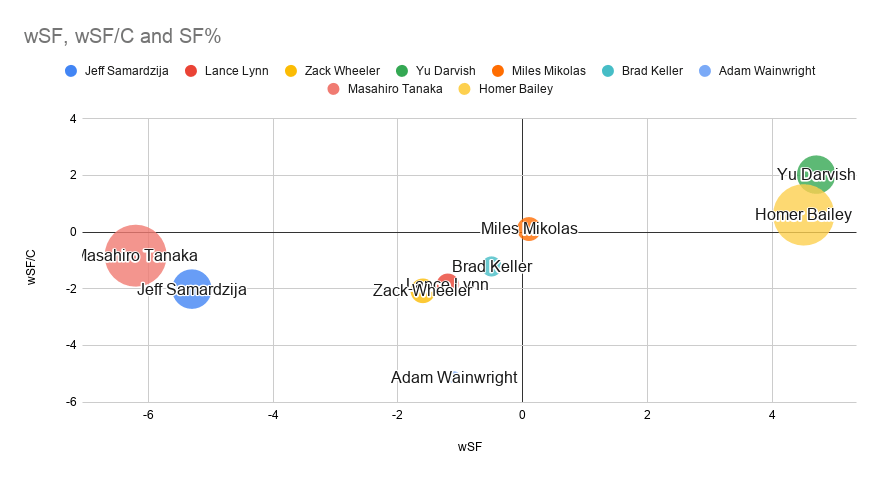
His splitter may have been the paramount reason why, but how this devolution occurred remained a pressing question. The answer most likely lies in the baseballs Tanaka was throwing. In a Fangraphs article by Jake Mailot, he discussed a separate New York Times piece by James Wagner. Wagner wrote about the “juiced” ball, and how the new ball forced Tanaka to face the music of old habits and change his grip. It quickly became necessary for Tanaka to change things up, as his aforementioned two-month stretch of putrid pitching wouldn’t cut it for a competitive New York Yankees team.
Wagner wrote that Tanaka “used a drastically new grip for the first time [July 31st], setting his index and middle fingers across the seams instead of along them.” This was in an effort to limit the new seams’ effect on the ball. Those seams, which were lower than previous years, resulted in less drag (z-movement). Thus, balls dipped less as they traveled closer to the srike zone, at least in situations where seams were typically utilized.
With less sinking action came less pitches falling out of the strike zone. The result? 87 mph meatballs. It doesn’t take a rocket scientist nor a pitching coach to see how that is not a recipe for success.
Initially, as Mailhot noted, these improvements proved fruitful. An impressive August saw Tanaka rebound with a 3.30 ERA and season-low HR/9 (0.83) and WHIP (0.98). Additionally, he ran into some bumps in the road in the season’s final weeks, but finished the regular season on a largely-positive note. This trend continued into the postseason, where, in 16 innings, Tanaka sported a 49 ERA-, 2.25 ERA, and .148 BAA.
Looking forward
As we stumble towards a new season, it is clear that nothing is guaranteed. From safety to games played to the performance in those potential matches, nobody knows what is going to happen, how we’ll get there, or if we’ll even get there at all. In a 60-game season, baseball will see its first sprint. Its fans will be first-hand witnesses to the idiosyncrasies this sport thrives on, in doses we may have never seen before.
Projecting what is to come with any real accuracy seems to be an impossible task given the circumstances, so I won’t begin to try. Still, I remain hopeful for Tanaka’s future outings. He had a strong second half and stepped up when it mattered most. He’s shown the ability to make adjustments in the wake of a pressing issue. A plethora of encouraging trends continued, perservering an up-and-down September. For example, his hard contact and medium contact percentages both continued to drop with each passing month after July, unequivocally creating an uptick in soft contact. Tanaka continued to strike out an increasing number of batters as the season wrapped up, while also limiting his free passes. This isn’t to say that an offseason and three additional months off won’t add to already-looming age concerns, but there are plenty of reasons for optimism in the Bronx.

Despite my excitement, other methods of prediction are hesitant to share the hype. According to Fangraph’s ZiPS projection, Tanaka is set to plateau in his command, with a 1.98 BB/9. He’s projected for a 4.34 ERA and a 4.40 FIP, a mark that would be a career-worst. In a shortened season, it will be interesting to see how the projections hold up.
In the final days before a potential season, cautious optimism is shared and hope for some sense of normalcy continues. On the field, the trends found in Tanaka’s play last season are a bright spot in a dark season. That same sentiment seems to be all we are asking for with this upcoming adventure. If games are played, it is not out of the question that Tanaka performs at a level behind only Gerrit Cole on that Yankees staff. If I was a betting man, that’s where I’d put my money.
All in all, a multitude of lessons can be learned from the case study that is Masahiro Tanaka. Pitch values, when put in context, can tell a story. These values are inherently indiscriminate between seasons, merely a reflector of a point in time rather than an indicator of future success. Yet, when used properly, pitch values can help us peer into the ever-uncertain future and take some guesses of what is to come. For Tanaka, it’s almost time for his next chapter. It’s up to him, and his revitalized splitter, to write it.
 frontdoorfastballs.com