
In Washington, Anthony Rendon will be remembered as a critical part of the franchise’s first World Series championship. After departing for the Los Angeles Angels in free agency, a hole emerged in the middle of the National’s lineup. Washington hopes Carter Kieboom can fill his shoes and contribute for a team desperate for wins in a feisty NL East.
Manager Davey Martinez gave Kieboom a vote of confidence this winter, proclaiming “He can do the job” (Washington Post). Since then, however, Kieboom has largely been disappointing in spring training. In 24 at-bats, Kieboom has garnered six hits, only one going for extra-bases. He has matched his hit totals with equivalent walk and strikeout numbers. Despite reportedly gaining weight over the offseason, his empty home run column is concerning to sum.
Now, spring training performance is by no means the most important aspect of player analysis, nor is it an adequate predictor of future performance. Still, performance in these games matters when one is fighting for a starting spot. Asdrúbal Cabrera is an option for Washington at the hot corner, and his veteran presence could eventually give him the edge for Opening Day.
Even so, Kieboom struggled when he first broke into the league last year, so much so that he was left off the postseason roster. Across 39 at-bats, he slashed .128/.209/.282 with a 37.2% strikeout rate. Small sample sizes and a poor acclimation to Major League pitching don’t exactly paint a pretty picture, but nearly every other piece of evidence should excite Nationals fans.
For one, Kieboom raked in the Minor Leagues. While in single-A, he racked up an impressive 158 wRC+, only to back it up with a 149 wRC+ in high-A. Last year, in AAA, Kieboom maintained a .362 BABIP and .388 wOBA. It’s easy to see where his hype comes from. A former first-round pick, Kieboom has looked the part every step of the way in the Minor Leagues. Subsequently, Kieboom was named FanGraphs’ 21st overall prospect, and the 74th overall prospect via The Athletic’s Kieth Law.
Unequivocally, performance in the batter’s box is what will make Kieboom money at the next level. Going off of his brief Major League stint, it would appear Kieboom is has a rather patient plate approach.
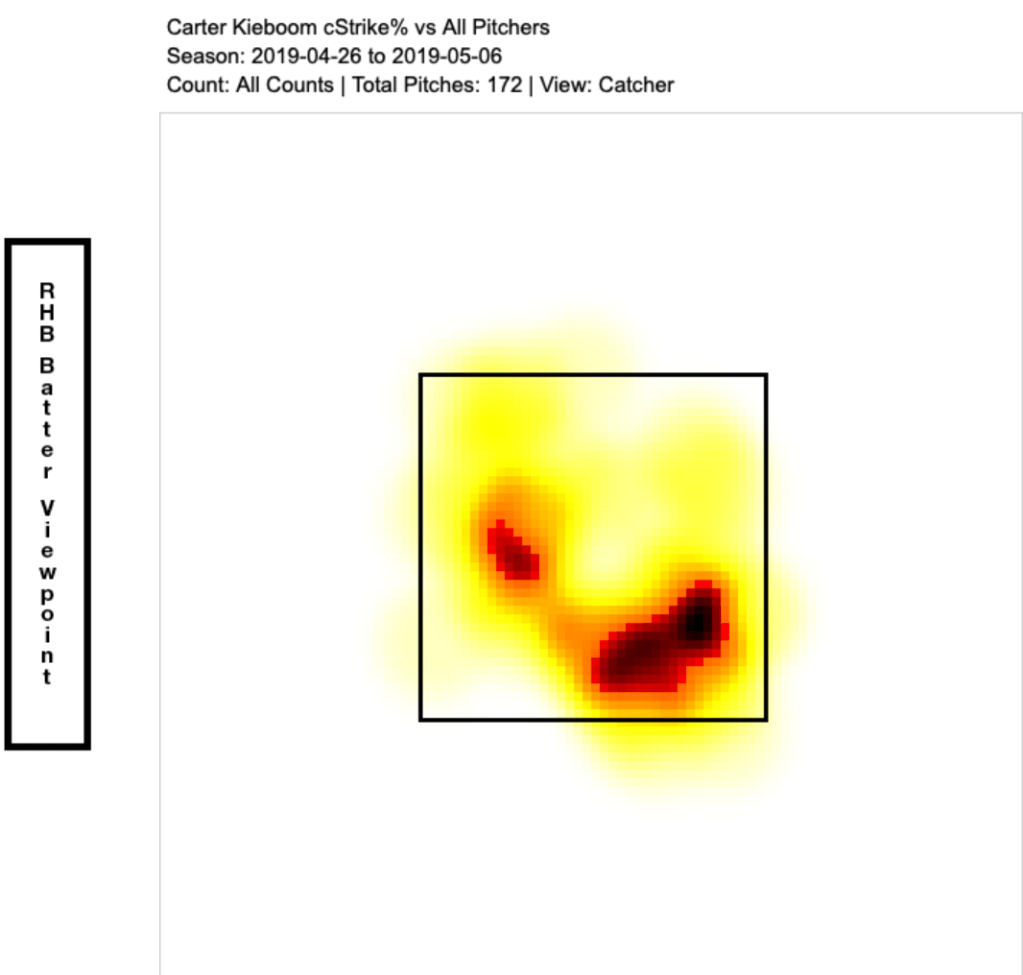
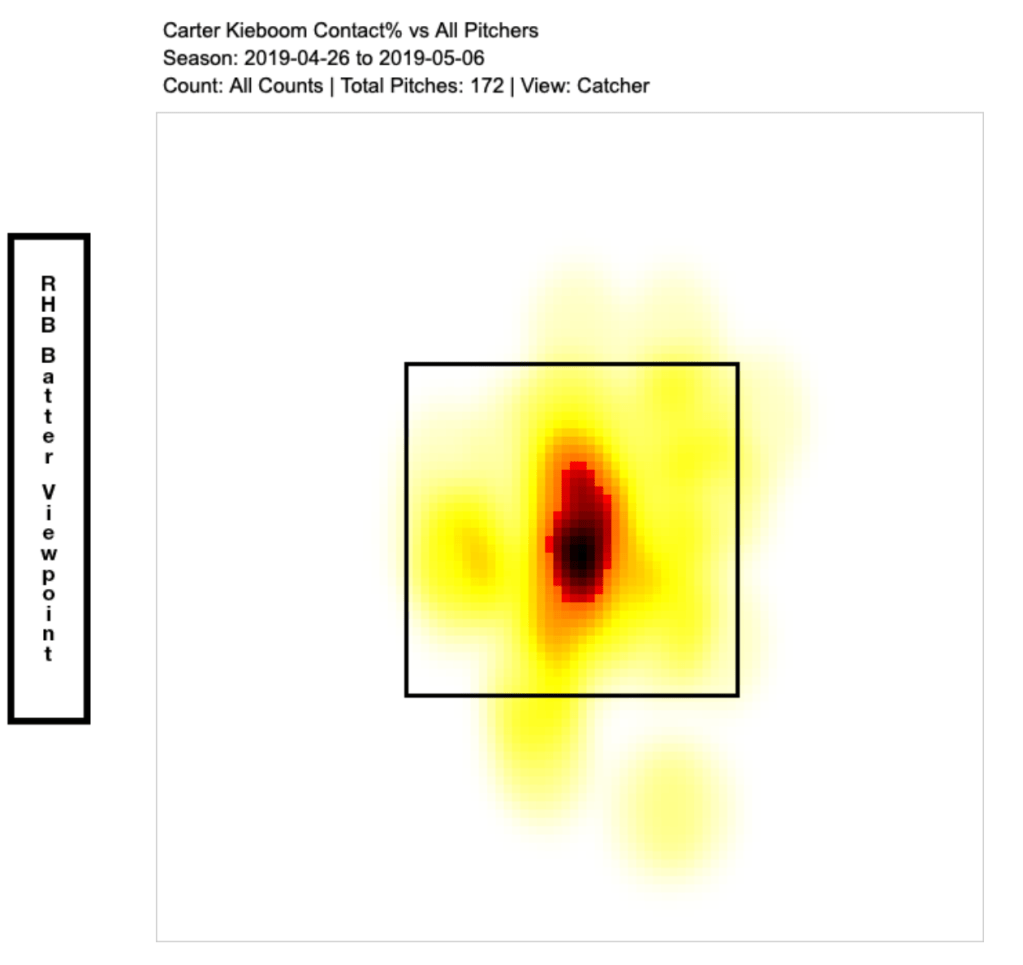
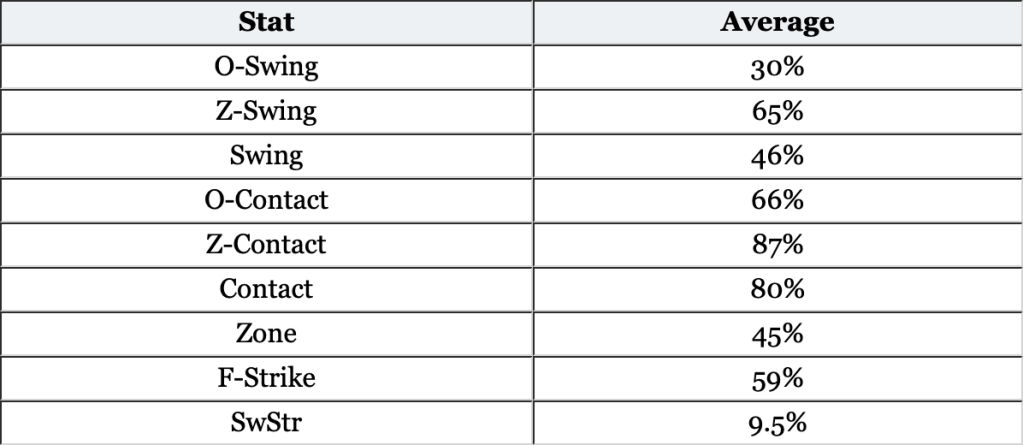
As we can see above, Kieboom is more likely to take pitches on the lower-outside part of the strike zone. His patient outlook is supported by a 35.7% Swing percentage, 24.2% O-Swing percentage, and 49.4% Z-Swing percentage. All of these are well below league-average estimates. Unsurprisingly, his BB/K ratio surpassed the (Major League) average of 0.4 at A, high-A, and AAA.
Interestingly enough, Kieboom finds the most success on a vertical plane, instead of a horizontal plane over the heart of the plate. Naturally, with less swings typically comes less contact, but optimism can be manufactured from the contact he does make. He can hit to all fields, something that can be predictive despite his small sample size with Washington last year. Kieboom pulled 26.1% of the contact he made, while an equivalent (!) 26.1% went to the opposite field, and 47.8% of his contact were hit towards center field. Furthermore, Kieboom’s limited contact was not particularly poor contact. Of all balls he put in play, Kieboom made “hard contact” (determined by Baseball Info Solutions) 43.5% of the time, surpassing the league average of 30%. His medium contact percentage of 47.8% is slightly below average, but deemed a positive when considering his infatuation for hard contact and an incredibly low 8.7% soft contact percentage. He struggled to make contact, but when he did, it was largely of quality and to all fields.
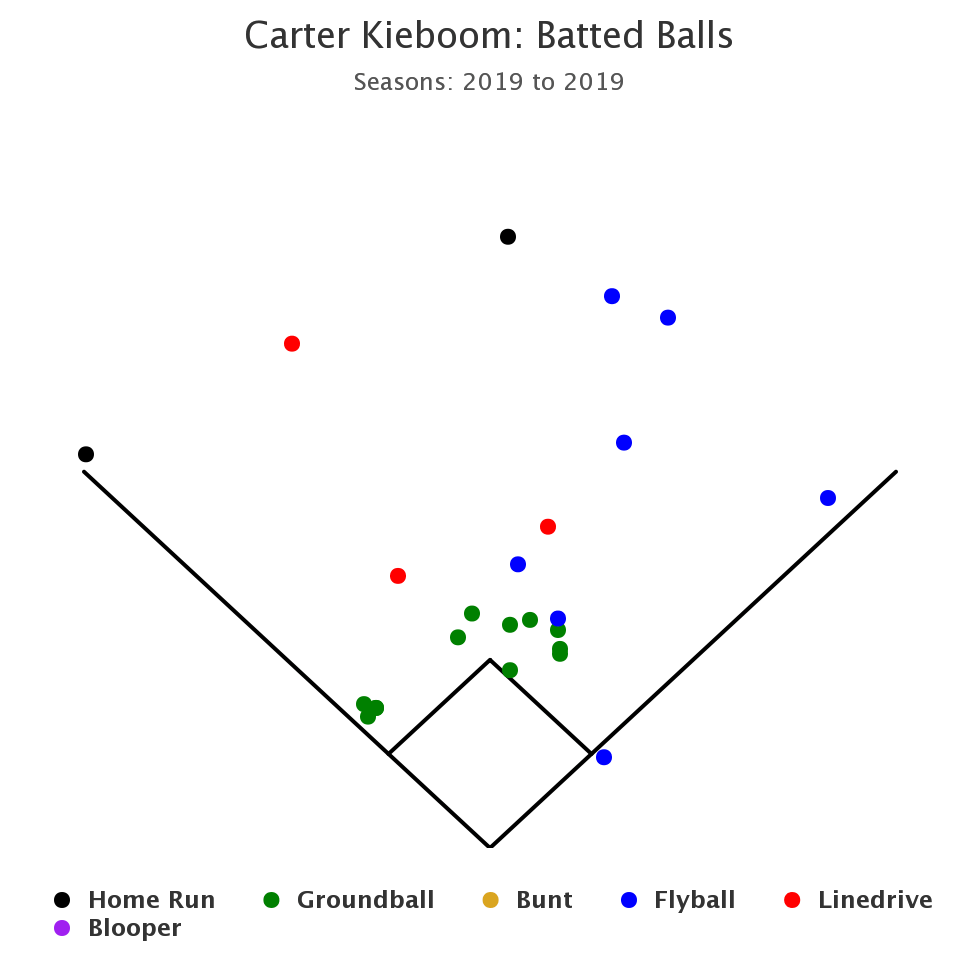
Kieboom’s power is well-projected and a large part of his potential. His ISO (SLG-AVG) is one way to gauge his power, even with few plate appearances and generally poor performance. His ISO of .154 was above the average of .140, and considering his previous play in the bigs should be considered his floor, this only projects to get better. His ZiPS three-year projection shows an improvement to ISOs of .159, .180, and .188, all quality scores. According to a FanGraphs scouting report, Kieboom (and Keston Hiura) “create [an efficient loop] as they accelerate through the hitting zone,” which, “enables Kieboom to hook and lift stuff on the inner half, including breaking balls, and he’s especially adept at driving stuff away from him out to right.” An abbreviated version of said report also states that he has 30 home run power to all fields.

Here, Kieboom is listed as a shortstop, where he has spent most of his professional career. We’ll touch more on that later. His ZiPS projection shows a rookie with adequate talent to start, but a somewhat limited ceiling. A 1.7 WAR is only 0.3 wins more than Cabrera, who would presumably fight for playing time. A middling slash line doesn’t spark much optimism, but we can begin to see the power he’s been thought to have. For a middle-to-bottom of the order piece (for now), Kieboom’s prophesied 16 home runs would be acceptable, especially considering his early struggles at the plate. The aforementioned three-year projects slots him in for 16, 18, and 19 home runs during the allotted time frame. Personally, the top prospect’s hard hit rates are encouraging, as well as his patience and ability to drive the ball to each part of the field. Once he is used to Major League pitching, that 16 home run bar is a realistic one to clear.
Moreover, Kieboom’s ranking as a top-end prospect stems mainly from his bat; that much is clear. There are a myriad of other questions left unanswered with the remaining three tools of his game. Described as “heavy-footed,” an apparent lack of speed mitigates his offensive impact, unsurprisingly on the base paths.
Kieboom saw his speed manipulate his defense, too. With Trea Turner starting at shortstop, Kieboom is slotted to step in at third base, despite limited experience. Thus far, he has struggled to hold down the hot corner. Some have attributed his defensive struggles to poor offensive performances and vice-versa. He’s made his splash plays, and possesses a strong enough arm to be an effective third basemen, but his inexperience has reared its head on multiple occasions.

As for improving his game, progress with his glove should be natural. Even if his ceiling is limited as a fielder, his arm compensates for some miscues, and he is playing a position that typically asks for offensive production. At the plate, Kieboom showcased the ability to do damage against changeups and sliders, but was frighteningly below-average against essentially everything else. This can be seen by his PV/100, which attempts to quantify his success for each pitch while compensating for varying sample sizes. Cleaning up his game against high-velocity pitches will be paramount for his offensive production. He can hit off-speed pitches in limited doses, but will need to improve against fastballs before they’re the only thing he sees. Said improvement could work wonders in gathering him more favorable pitches, creating more contact, and with his power, extra-base hits.
Kieboom will look to join the ranks of Turner, Juan Soto, and Victor Robles as young staples for a Nationals team hungry for a second championship. In the toughest division in baseball, his play not only matters, but could make or break Washington’s season. He’ll have the opportunity to win (and presumably re-win, if necessary) the third base job, and even playing to his 1.7 win projection can keep Washington alive. Without a breakout season from an unsung Nationals hero, poor play from the team’s top prospect can render them an easy candidate for fourth place in the NL East. Outplaying his projection could render Kieboom the X-Factor Washington needs to compete for another championship.
 frontdoorfastballs.com
One thought on “Carter Kieboom a potential X-Factor for repeat-hungry Nationals”