
Featured Image Credit: Mitchell Layton/Getty Images
April is quickly approaching, promising a new baseball season and the ever so cliché notion that nobody has been eliminated yet. Zero wins, zero losses, and an equivalent shot at taking home a championship come October.
Of course, math gets in the way, probabilities come to light, and we eliminate the Baltimore Orioles from playoff contention.
For the other 29 franchises, the fresh start offers hope and energizes fanbases as they get acquainted to newly acquired stars. They get their first look at prospects and keep tabs on returning veterans. The warm weather is a catalyst for hype, and as we face yet another marathon, each team has the same goal in mind.
Naturally, for one up-and-coming team, this fantasy will turn to fact, at least for a few months. Teams obliterating their expectations typically revolve around an influx of young talent, just ask the Padres of last year or the Cubs and Mets from 2015.
With a hodgepodge of veterans in their lineup and a questionable (at best) bullpen, it’s not too likely the Miami Marlins find themselves in a playoff spot after an 162-game season. However, their collection of young arms will be pivotal in the deciding of playoff fates among baseball’s best division. They may be enough to springboard Miami into success.
Pablo López
Make no mistake, no matter who toes the rubber on Opening Day, Pablo López is the best pitcher on this staff. He’s come a long way over the course of three seasons in the show and broke out in 2020. His 11 starts last season don’t provide the most significant of sample sizes, but López showcased tangible improvements that are likely to be sustainable.
Maybe the most underrated pitcher in baseball, López went into 2020 having already mastered the art of pitch tunneling. For those that don’t know, pitch tunneling is the ability to make different types of pitches look the same for longer periods of time by releasing them at similar points. The tighter the spread of a pitcher’s release points, the likelier one is to be good at tunneling.
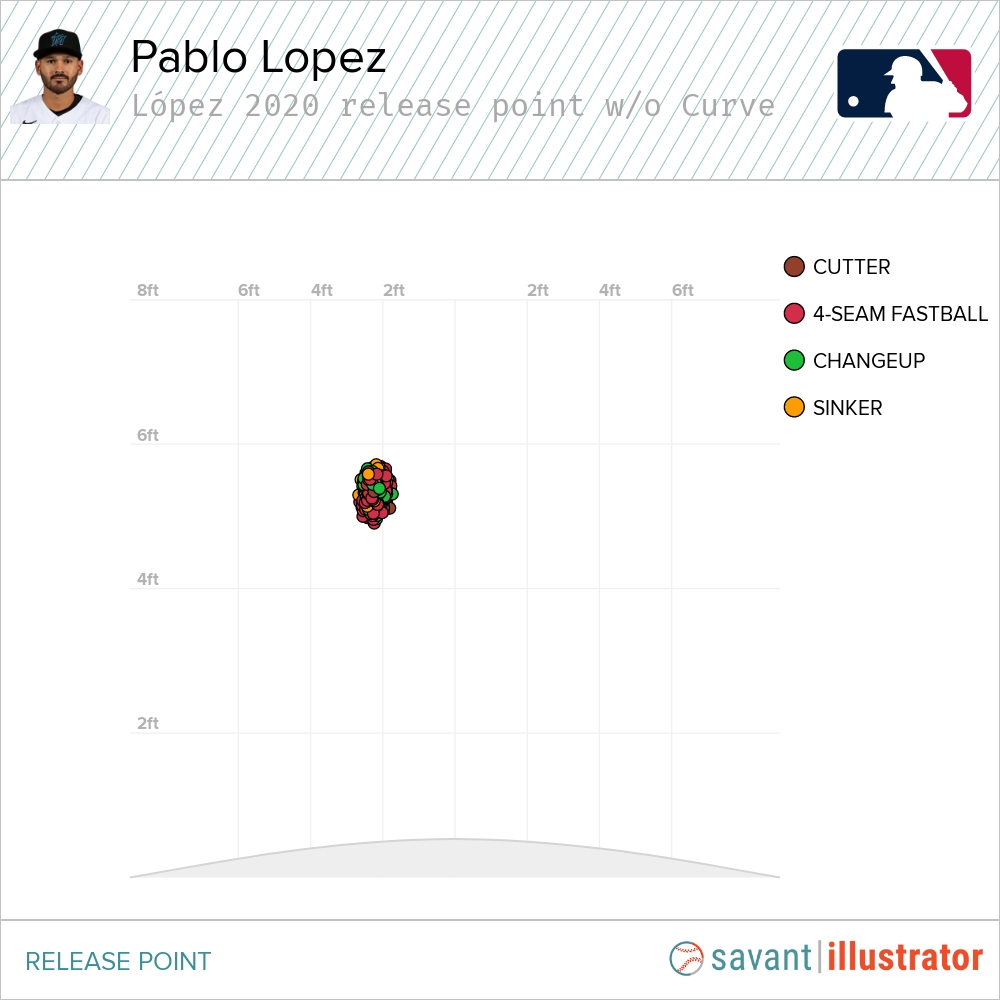
As you can see, it is virtually impossible to decipher which non-breaking pitch is coming based on release point. With a 4-seamer that doesn’t move much, a sinker that retains his velocity, and a put-away changeup, he was already dangerous. Adding a cutter in 2020 may have been the missing piece of the puzzle.
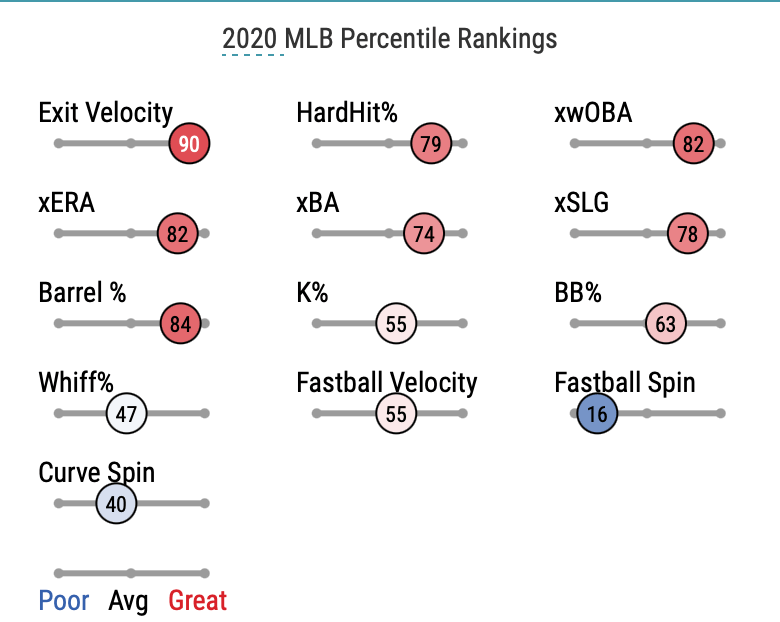
Seasons like this don’t just happen out of the blue. The latest addition to his repertoire helped him amplify his pitch-tunneling prowess. By adding a pitch with glove-side movement that wasn’t his curve, he was better at keeping hitters off-balance and forced hitters to worry about a horizontal plane, rather than just a vertical one.
The results were plentiful. Even without his cutter putting up dominant results (0.32 wFC/C according to Pitch Info), his 4-seamer saw an increase of over 100% (0.29 wFA/C in 2019 to 0.66 in 2020) and his sinker was elevated to a premier pitch, jumping from 0.76 wSI/C to 2.47 and being thrown approximately 22.7% of the time.
This culminated into a 3.98 SIERA, a 3.09 FIP, and a 72 FIP-, good for 35th, 16th, and 21st in the league, respectively, among pitchers with at least 40 innings pitched. López has already arrived, even if the league hasn’t noticed yet, and he’ll have a chance to repeat his performance without the pressure of media-driven expectations.
Sandy Alcantara
The first of two Marlins starters with sky-high expectations is prospective ace, Sandy Alcantara. The biggest part of the return from the Marcell Ozuna deal, being Miami’s ace seemed like a disposition.
He pitched fairly well last year, sporting a 71 ERA- and an 86 FIP-. More importantly, he saw legitimate improvement from his less flattering 2019, as he struck out batters at a 22.7% clip while also seeing a decrease in walks. Still, the control is an issue; an 8.7% BB% is nothing to write home about. His .310 xwOBA was 133rd among qualified pitchers and on par with Josh Lindblom. He’ll get the nod on opening day, but I wouldn’t count on him being the best pitcher on the staff.
That doesn’t mean there isn’t plenty to be excited about, either. The Marlins clearly have their type: strong sinker/changeup combinations. Alcantara doesn’t deviate from that and is much like López in that regard. His fastball is superior and still improving, averaging out at 96.8 mph, a 1.2 mph increase from 2019.
Alcantara’s 6-foot-5, 200-pound frame promotes that growth. He has the athleticism to tinker with his mechanics to improve upon his control woes. Getting him into more pitcher-friendly counts would make his raw, but dangerous, slider and changeup that much more effective. Throw in the natural run his fastball and changeup have and it’s easy to see why Marlins fans have bought into the hype.
Sixto Sánchez
Traversing through baseball’s toughest division gets a little bit easier when things go as planned. One such occurrence is the arrival, and strong performance, of Sixto Sánchez.
Acquired in the J.T. Realmuto trade, the pressure’s been on Sánchez to make an impact and pitch atop Miami’s rotation. In his seven starts last season, he showed us why he was so esteemed, pitching to a 3.50 FIP. Sánchez displayed a consistent ability to stymie opposing power hitters, allowing only six extra-base hits in 2020.
Gifted with the ability to keep the ball in the ballpark, Sánchez is expected to be a reliable innings-eater at the very least. One doesn’t become a top prospect following that formula, however. He doesn’t possess an elite fastball, yet the strikeouts are likely coming in 2021, giving him a chance to live up to his highly-anticipated potential.
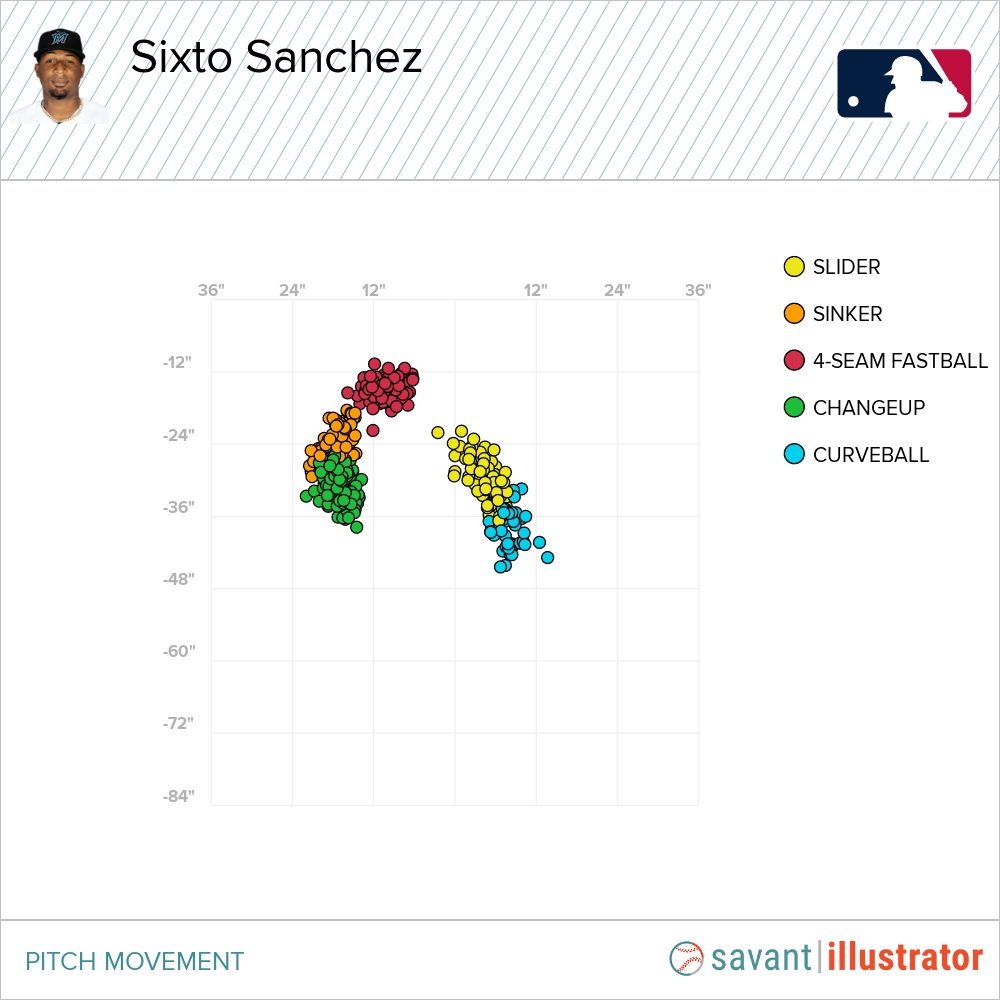
Part of what makes Sánchez special is his versatile arsenal. He’s able to attack East and West to right-handed batters and has enough velocity on his fastball to work the numbers and set up his changeup elsewhere in the zone.
That changeup, a Pitching Ninja frequent, is easily his best pitch. A circle-change with over 17 inches of horizontal break to its name, it led all of his pitches with 28.1% Put-Away rate and accumulated -7 Run Value in as many starts. When batters were fortunate enough to make contact, they produced a xwOBA of .189 and a batting average under the Mendoza Line. To add, Sánchez’s changeup pairs perfectly with his sinker. His two most common pitches last season, he’s built his game around impressive tunneling skills and an exceptionally cooperative repertoire.
Moreover, Sánchez must improve against one side of the platoon if he is truly going to make it in the league. Surprisingly, this progression must come against right-handed hitters. He posted a 4.26 ERA and 1.42 WHIP against arm-side foes last year. Against left-handed bats, those numbers dip to 2.70 and 1.00, respectively. Personally, this was fascinating as his track record and pitch selection make 2020 an anomaly. What gives?
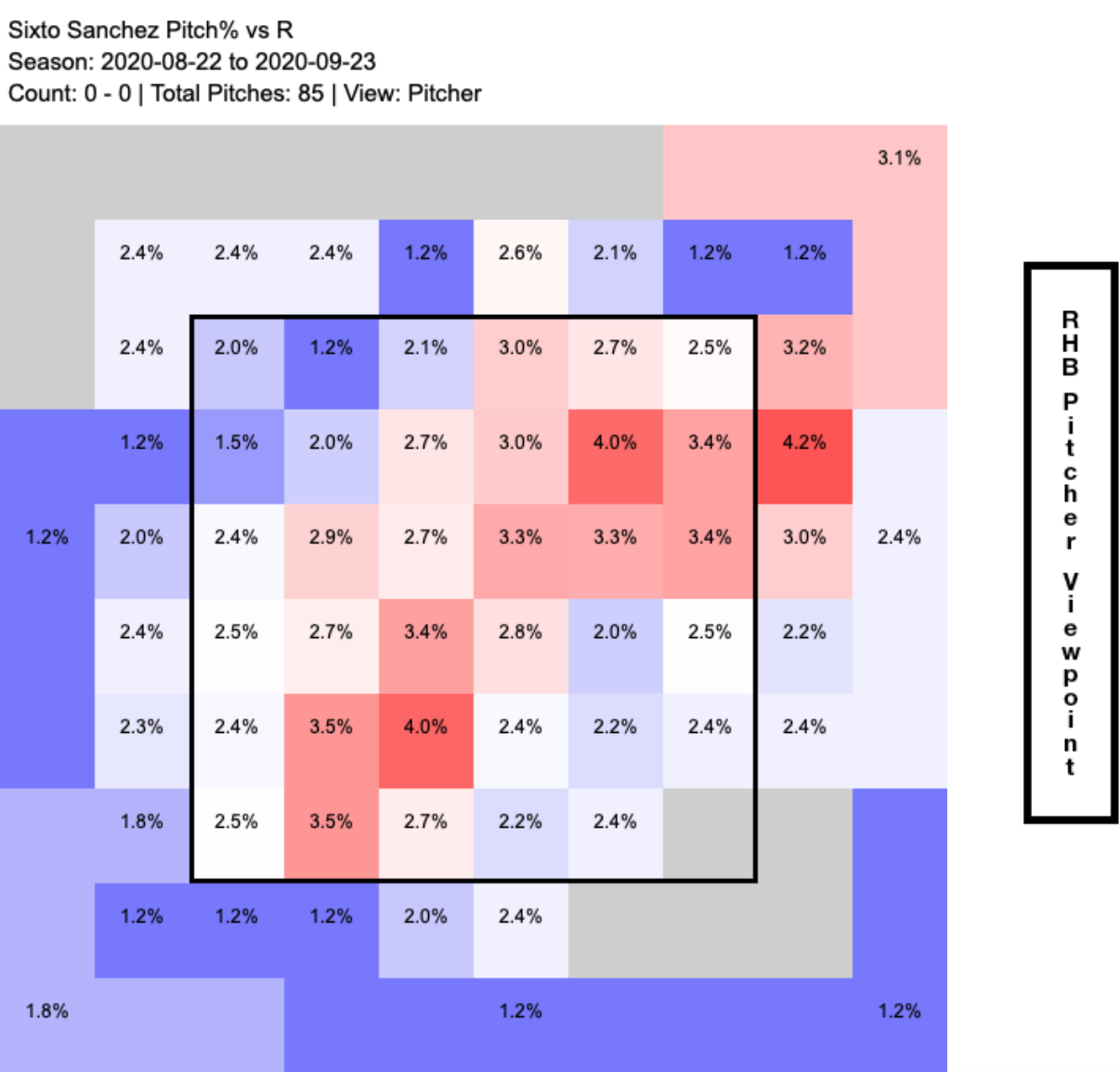
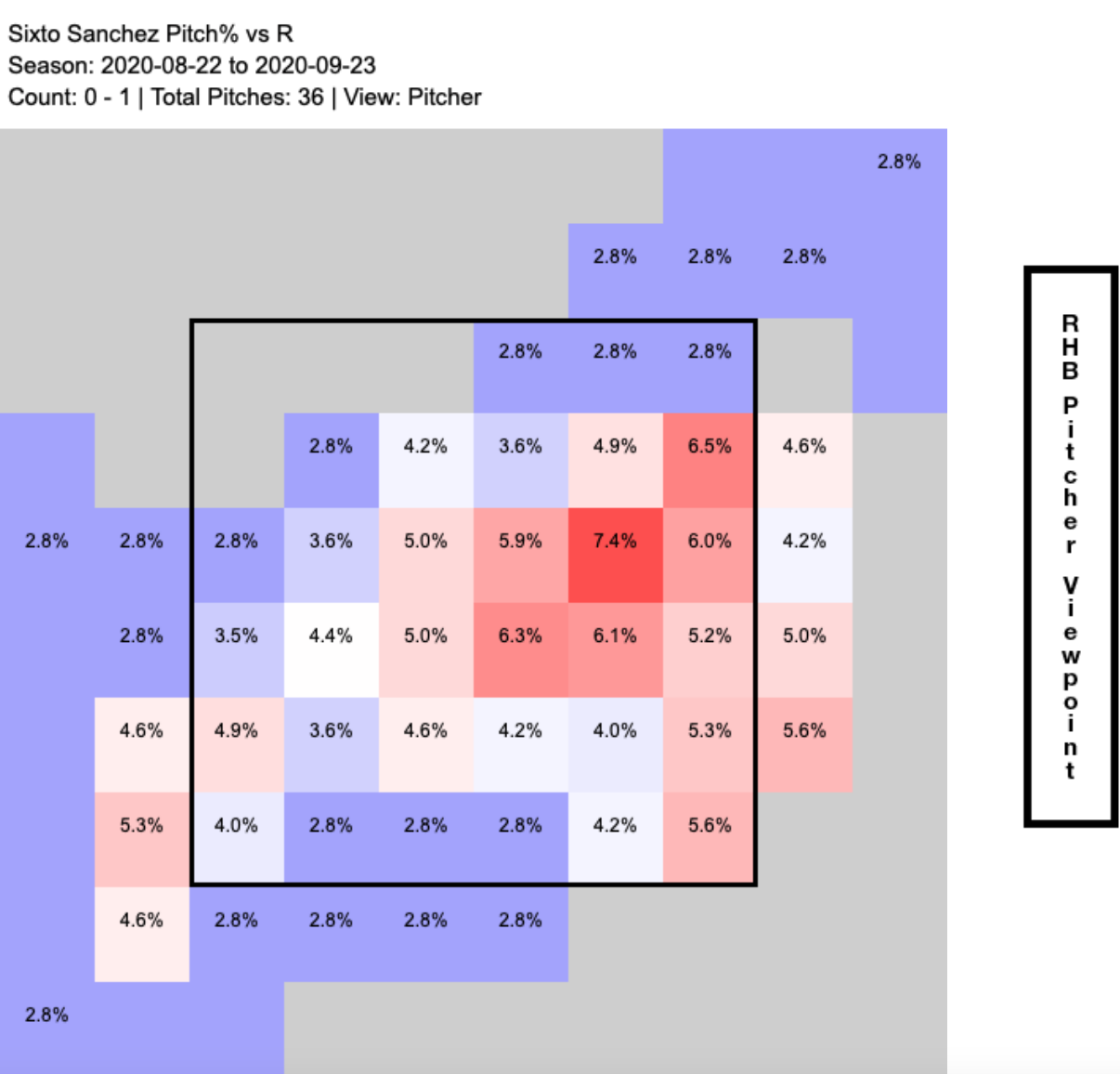
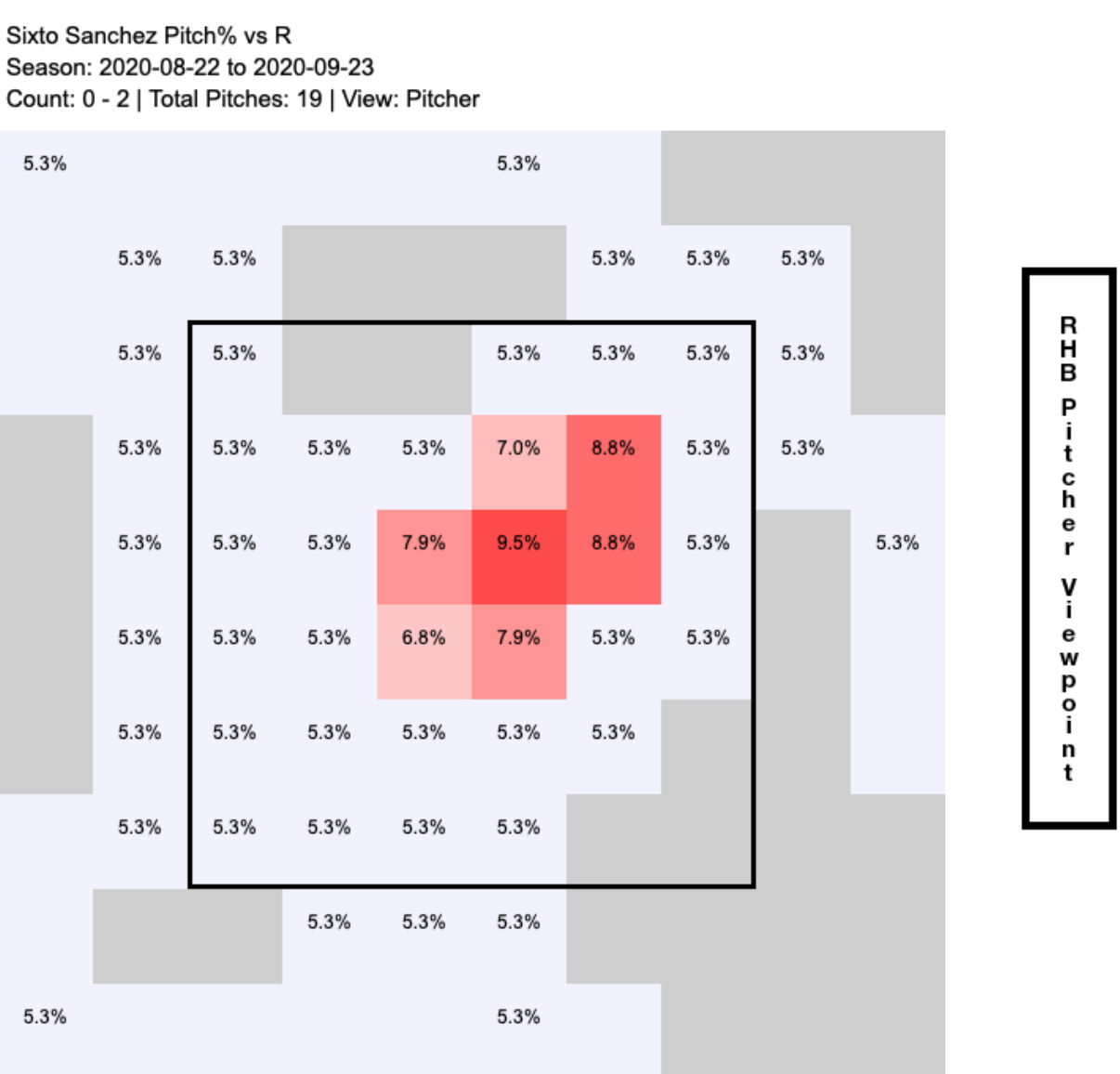
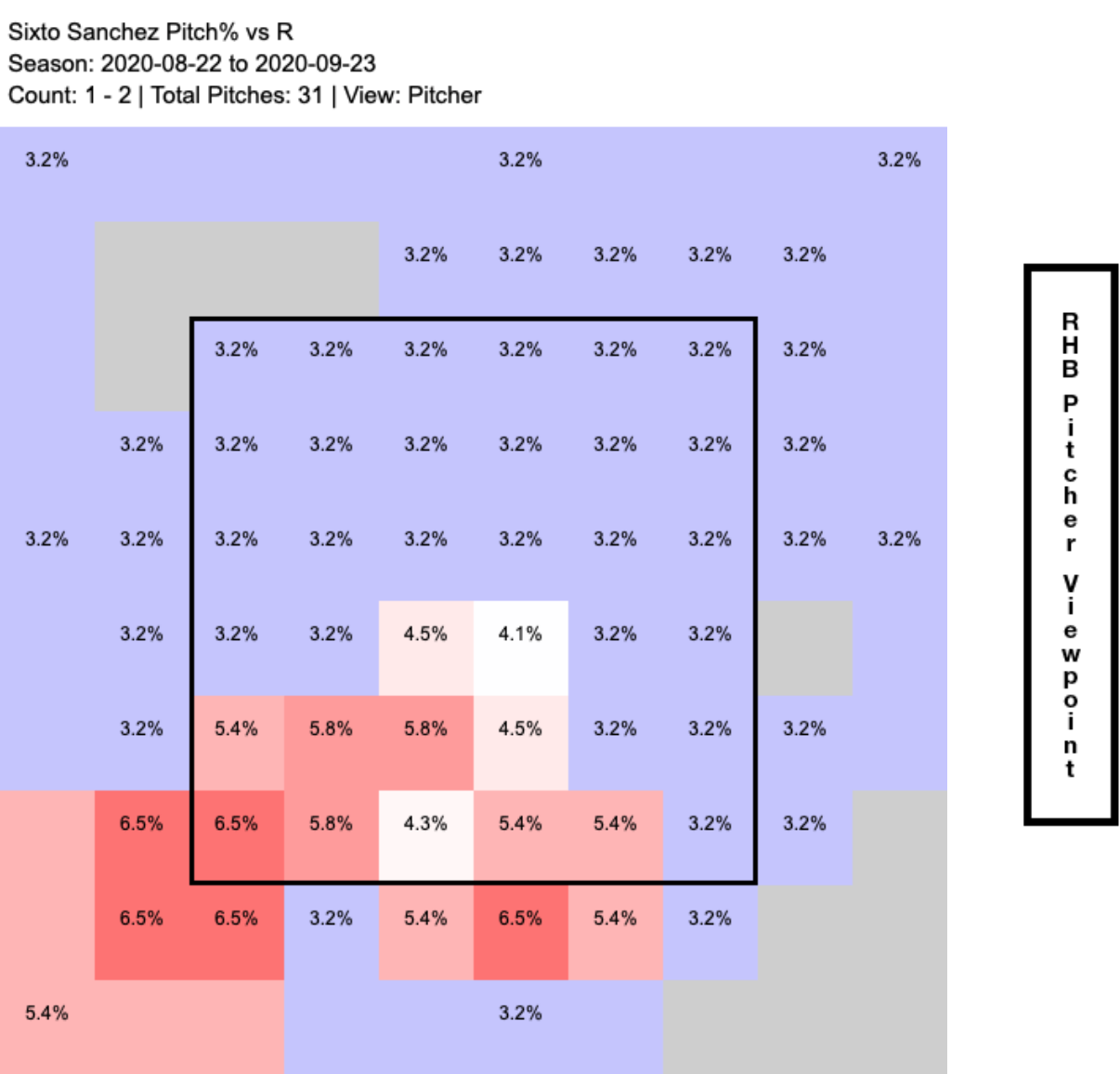
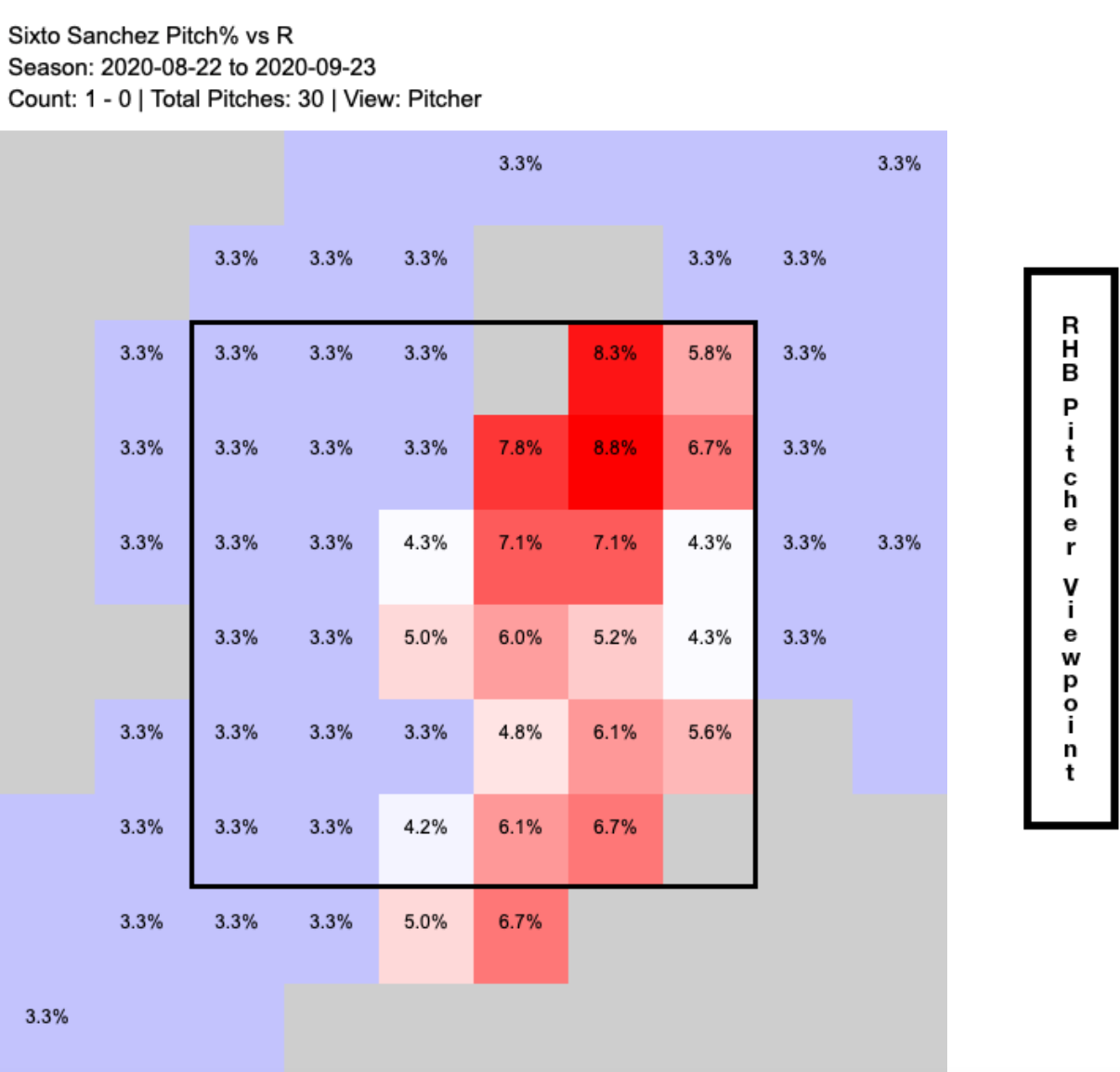
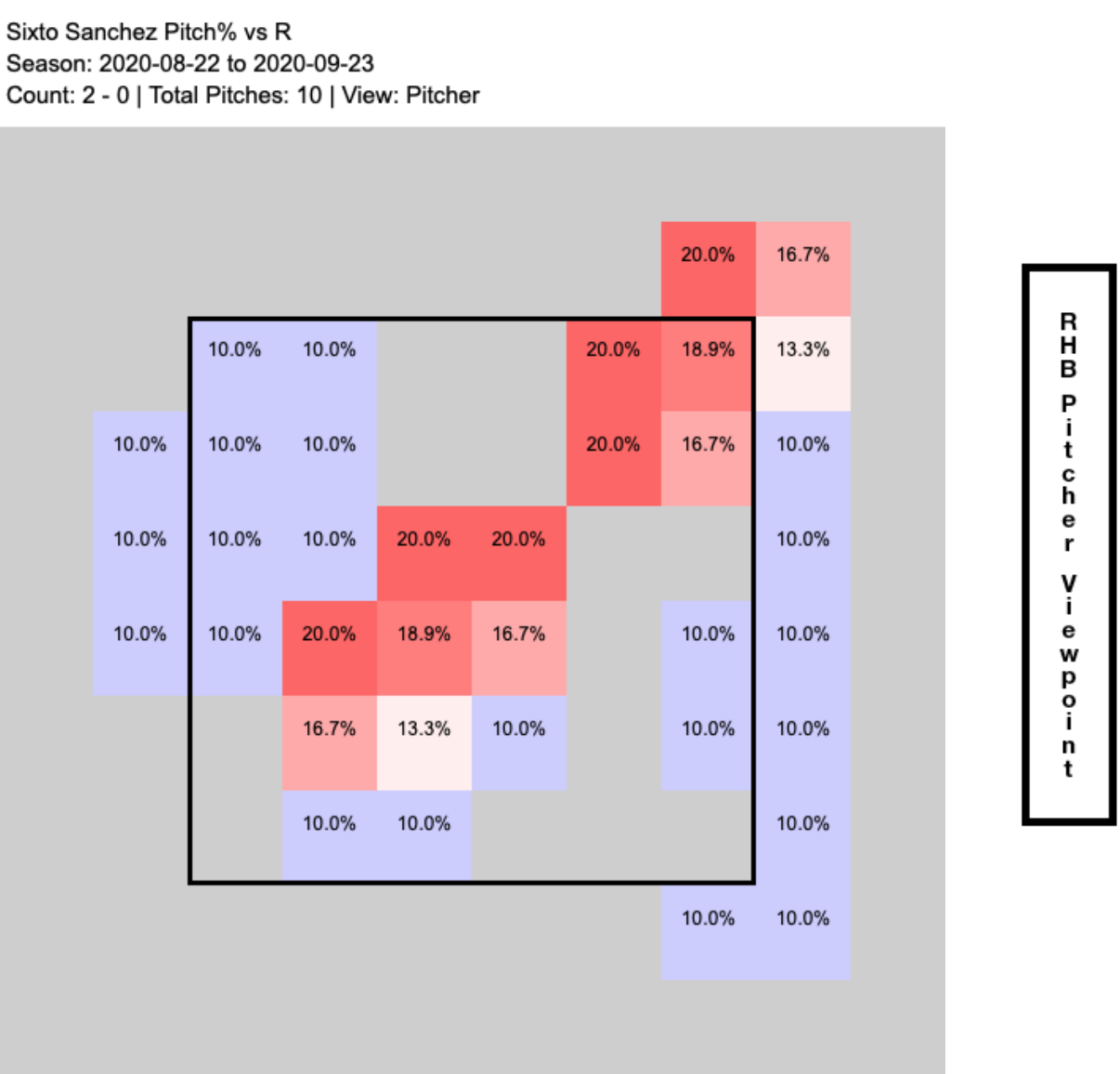
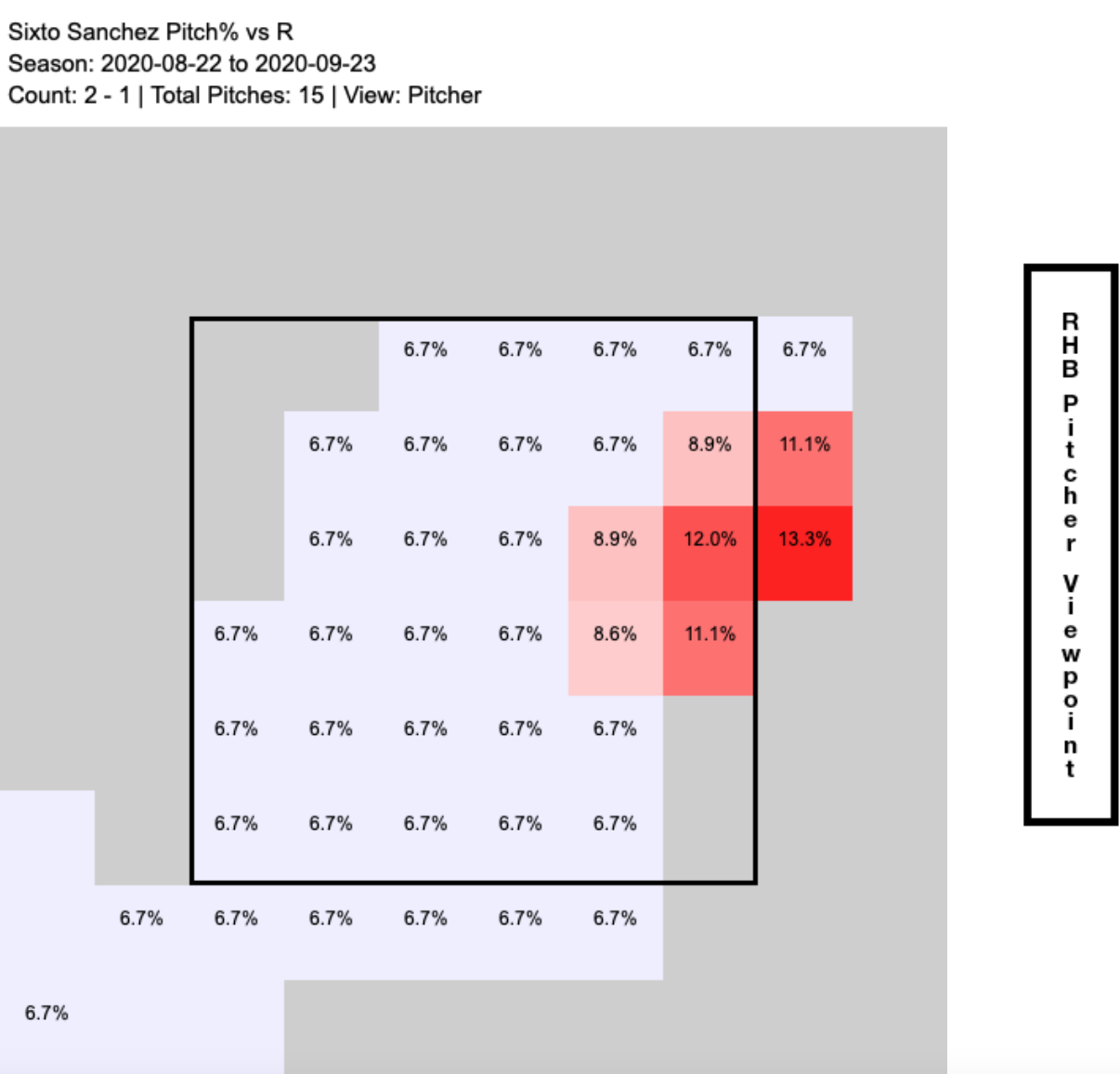
It seems Sánchez’s struggles last year were a result of count leverage and comfort. As the above images show (in an albeit small sample size), he was unsurprisingly able to keep hitters off-balance and remain unpredictable when ahead in the count. Even though he still played to his strengths on the arm-side of the plate, he was more willing to use his breaking pitches to get hitters to chase.
Moving forward, it will be important for Sánchez to use his slider and curve as front-door pitches on the inside part of the plate. He’s got the requisite command, and it would theoretically keep him ahead of batters more often and grant him an alternative to relying too much on his fastballs and changeup. His pounding-the-zone style of pitching is certainly a good thing, but embracing the borders of the zone could take his game to the next level. With an increased appetite for strikeouts and a remedied approach to right-handed hitters, Sánchez can quickly rise to the top of this rotation.
Trevor Rogers
Unequivocally, spring training stats should be taken with a grain of salt. Still, what Trevor Rogers has done in pursuit of a rotation gig has been impressive. As of March 27th, Rogers has posted 2.84 ERA in 19 innings, with a 13.7 K/9, 0.95 WHIP, and .191 opponent batting average. His work has all but guaranteed him a spot every fifth day for the near future.

Rogers’ 2020 was intriguing, particularly due to the variance in his performance. As his percentiles exemplify, Rogers has strikeout stuff, limited opposing exit velocity numbers, and pitched to great “expected stats.” However, those daunting BB% and HardHit% percentiles tanked his year to an extent. His 6.11 ERA is mitigated by a 3.53 xERA, but his .340 xSLG is rightfully scary. When he gets hit, he gets hit hard.
Looking at Rogers’ arsenal, it’s clear why things can look so good when he’s on. He lives down in the zone with a running 4-seam fastball (that breaks horizontally 83% more than similar fastballs!) and a changeup with favorable break numbers, both vertical and horizontal. His other pitch of significance is a slider, though it’s generally known as a 40-level pitch.
Like Sánchez, the former first-round selection is known for pounding the zone. Yet, his walk rates were downright bad in 2020. Much of that comes down to the effectiveness of his slider.
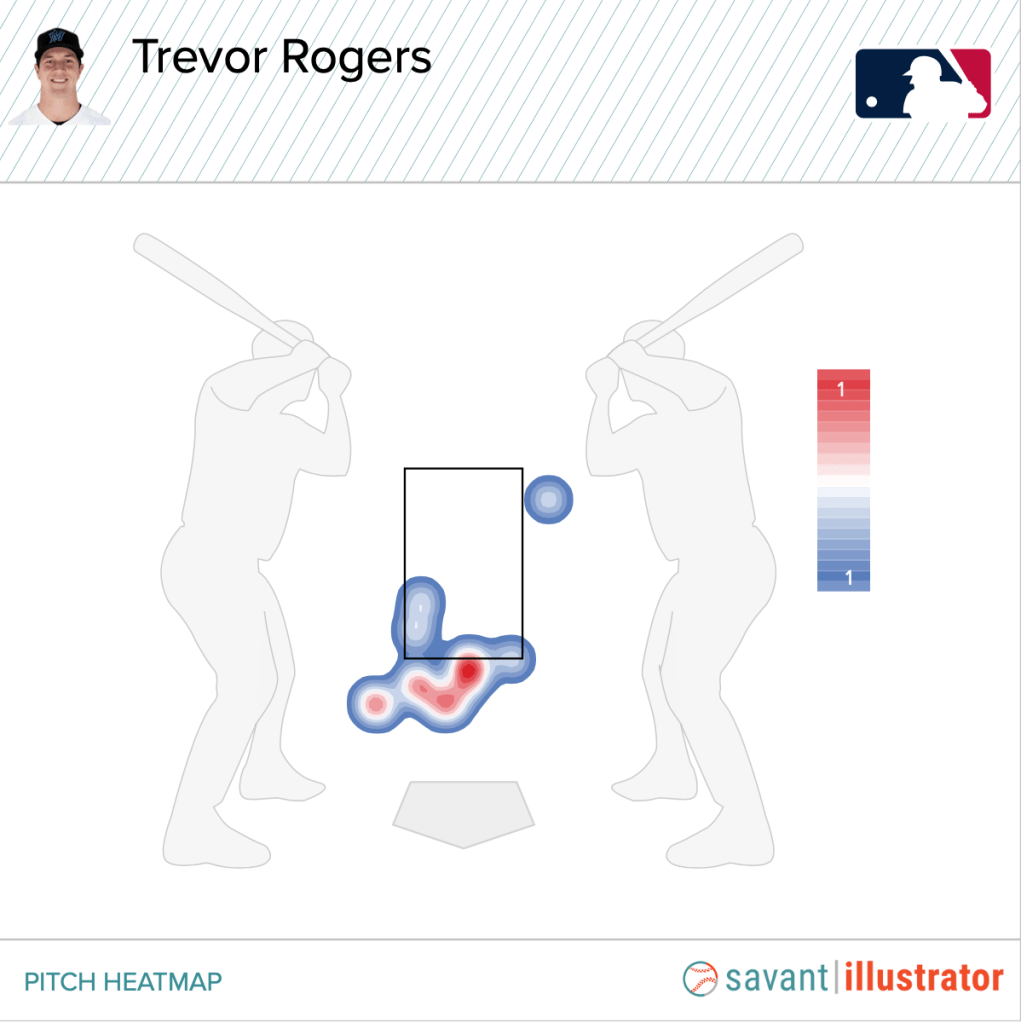
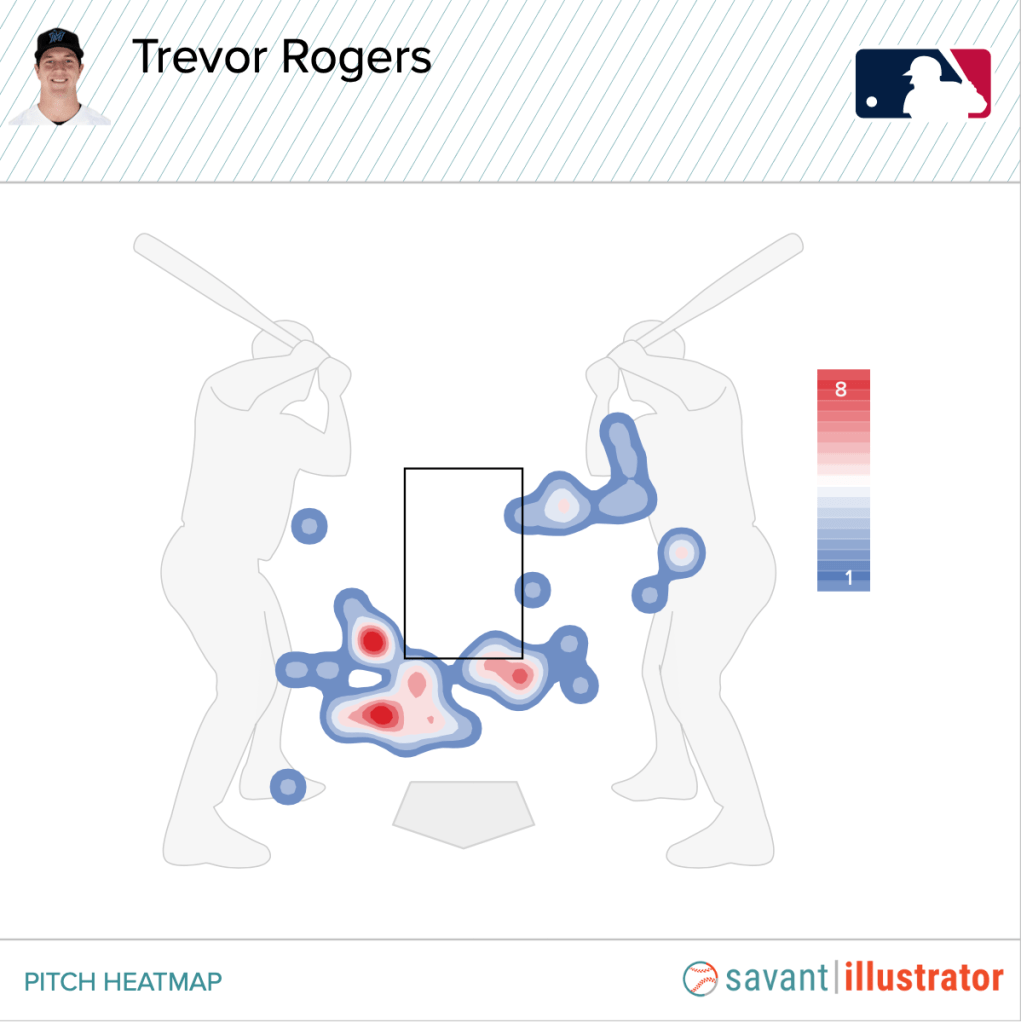
The first image above is a heat map of Rogers’ swinging strikes on his slider. The second are sliders that ended up called as balls. Rogers is struggling to get batters to chase his slider. That issue may be subsequent to its break, his slider has 84% less horizontal break than similar MLB sliders between 79 and 83 mph.
That in itself is far from a death sentence; Shane Bieber and Luis Castillo both have sliders that have at least 70% less horizontal break than similar pitches. However, the two compensate for that with better vertical break (12% and 6% more than average, respectively) and added velocity. Rogers’ slider has 7% less drop than expected. Both Bieber and Castillo throw their sliders above 84.5 mph, while Rogers averages 81.1 mph on the gun.
Rogers is less physically gifted, averaging just under 94 mph with his fastball. He’ll be forced to be more creative and rely on his fastball and changeup more, barring improvement any improvement. An uptick in changeup usage could help limit walks, as he’d be missing glove-side less frequently.
The traditional slider usage hasn’t worked for him yet, and continued struggles could relegate him to a bullpen role. If he’s focused on improving that slider, it may be in an effort to throw it over the middle of the plate, but below the strike zone. He got most of his whiffs there, and it could act as a second, de facto changeup. Retaining the ability to use three speeds (93 mph fastball, 84 mph changeup, 81 mph slider) and working vertically rather than horizontally could be the necessary adjustment. It’d be a lot to ask of a running fastball, but as long as he favors the lower two-thirds of the strike zone, it’s a strategy that could play.
Rogers has a rotation spot to start the year, but with the abundance of young arms the Marlins have yet to test at the Major League level, the clock is already ticking. There’s certainly a chance he lives up to his 50 FV hype, but the bullpen may ultimately be what is best for him. Here, he can experience a velocity boost (typically around two full ticks on the radar gun) and wouldn’t have to stress about locking down a third or fourth effective pitch.
The rest of the horses in the stable
Elieser Hernandez is the final starter in the Marlins’ rotation, but because I’ve now made you read 2,000 words on a team with more uniform changes than playoff appearances, I’ll keep things brief.
Hernandez throws as 92 mph fastball and a 77 mph cutter. That… doesn’t happen very often. He’s one of the most fun pitchers to watch in all of baseball, but despite his idiosyncrasies, he’s posted 3rd percentile exit velocities and gets barreled up far too frequently. Last year was a step in the right direction, but he may need to add another decent pitch to his arsenal (or improve on his changeup) to continue seeing improvement. He’s another strong bullpen option if a prospect starts to tailgate him.
Max Meyer was a top-ten selection in the 2020 MLB Draft and has legitimate upside. The college arm is only 6’0″ but can hit triple digits. Complimenting his fastball with a potentially 70 FV slider is going to result in big expectations. He’ll make a short stop in minor league camp but it’s possible we see him in Miami this season.
Edward Cabrera is an international acquisition that’s been compared to Sixto Sánchez on more than one occasion. He’s since lost some of his luster in terms of hype, but he’s got a decent shot at being a middle of the rotation starter. His 6’4″ frame and plus athleticism help amplify a strong fastball. The Marlins are betting on figuring the rest out, but his changeup and slider are relatively well-liked already.
Braxton Garrett, a former first-round southpaw, has already seen MLB action. Frankly, it didn’t go well. A soft contact percentage of 4.8% is unsustainably bad (thankfully), but not a great sign of things to come. He’s got a good curveball to his name, though it was his only effective pitch last season. He’ll need to improve upon his fastball and changeup if he wants a chance at joining Rogers as lefties in the Miami rotation.
Finally, Nick Neidert has a chance to return to the rubber in Miami this year. He lacks the upside the above eight pitchers possess, but he’s one of the more polished of the bunch. He boasts a 60-level curveball and command that helped him induce ground balls at a 60.7% clip. He wasn’t overly effective last season, but his 4.11 xFIP shows he can give you some decent innings.
All in all, the Marlins ending their playoff drought in 2020 was likely a fun, but isolated, part of their rebuilding journey. They’ll have to fight through what looks like baseball’s toughest division, but they can make some noise. Maybe it’ll just be in the role of spoiler; perhaps they stick around until school starts. In the event that everything clicks, they could find themselves again in October baseball. If that’s the case, it’ll be off of the arms of a slept on big three, a unique group of fringe Major Leaguers, and the rise of some fun prospects.
 frontdoorfastballs.com