Photo Credit: Brace Hemmelgarn, Getty Images
The Kansas City Royals have already used the 2020 season as a litmus test for their rebuild, showcasing young talent and kickstarting the graduation process for a handful of prospects.
Pitching has been at the forefront of the Kansas City rebuild. Five first-round arms crowd the top of their prospect rankings, creating a bountiful farm system that seemingly gives the Royals endless lottery tickets. It only takes one to hit as an ace to propel them back into relevancy.
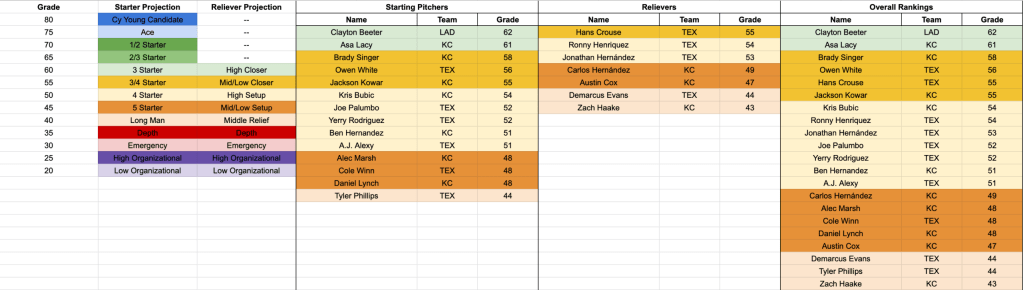
From 2020 fourth-overall pick, Asa Lacy, to Kris Bubic and Brady Singer, two rookies already contributing in the bigs, Kansas City fans have plenty of reasons to be excited. As a whole, though, I remain slightly pessimistic on the outlook of the farm system. The following is the Royals’ Pitching Prospect Primer.
For a brief introduction to this series and the first Pitching Prospect Primer, click here.
10. Zach Haake, Relief Pitcher, 43
The first prospect of this primer and the tenth-best pitching prospect (with film*) in the Kansas City organization is Zach Haake. Haake’s three pitches sprouts some optimism, with impressive velocity on his four-seamer and good horizontal break on his slider. Neither are as developed as his changeup, which is already an MLB-level pitch. He locates his changeup well arm-side and it is currently his only legitimate weapon against left-handed hitters.
*Pitchers without tape aren’t profiled, despite being consensus top prospects within their organization. In this case, Jonathan Bowlan was not included.
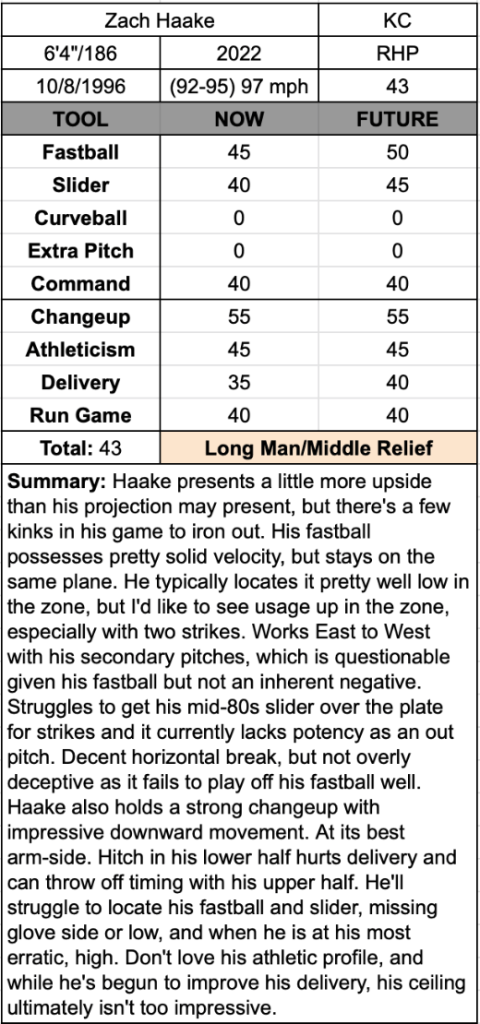
That inability to pose threats to lefties stunts his ceiling, as he is likely to deteriorate on the second or third time through the order. Otherwise, his lack of command is the most significant obstacle in his path to professional contributions. Without the command to paint his glove side, he becomes more one-dimensional and limits the effectiveness of his slider. The lower-half of his delivery plays a role in this, but below-average athleticism scares me more in regards to long-term improvement.
9. Austin Cox, Relief Pitcher, 47
Cox is the pitcher in the farm who can benefit the most from a move to the bullpen. Lacking dynamic stuff, Cox doesn’t seem like an immediate fit, but the inherent velocity boost a move to the bullpen brings can turn him into a versatile multi-inning reliever. When he is at his best, he is painting the bottom of the zone and letting hitters fish for his secondary pitches in the dirt. Unfortunately, consistently reaching that level of play has so far eluded the 23-year-old.
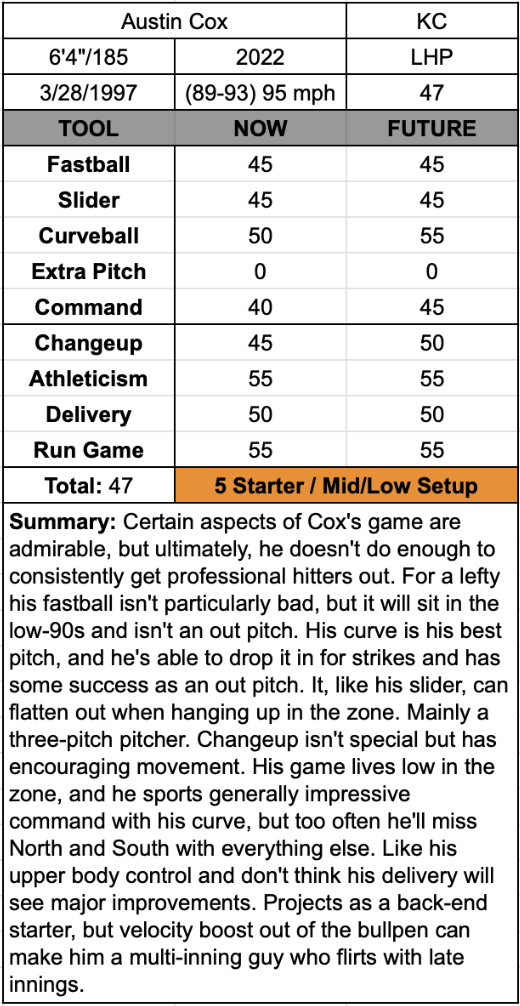
His off-speed pitches have their flashes, but he has the tendency to leave them hanging up in the zone, where they will unsurprisingly get barreled up. Cox’s command is a key to his success as he lacks a high-level fastball to keep hitters off balance. Lacking consistency here leaves him susceptible not only to walks, but the long ball as well. The most realistic projection is likely converting to a bullpen arm who can be stretched out if necessary.
8. Daniel Lynch, Starting Pitcher, 48
This piece’s first true starting pitcher, Lynch is one of the prospects I’m lower on than the consensus. The third-overall Kansas City prospect by FanGraphs’ estimations and the fourth-ranked Royal by MLB Pipeline, Lynch certainly has the hype behind him. His repertiore is deep, but far from lethal. Without impressive command, his stuff will need to take a leap if Lynch is going to live up to the expectations.
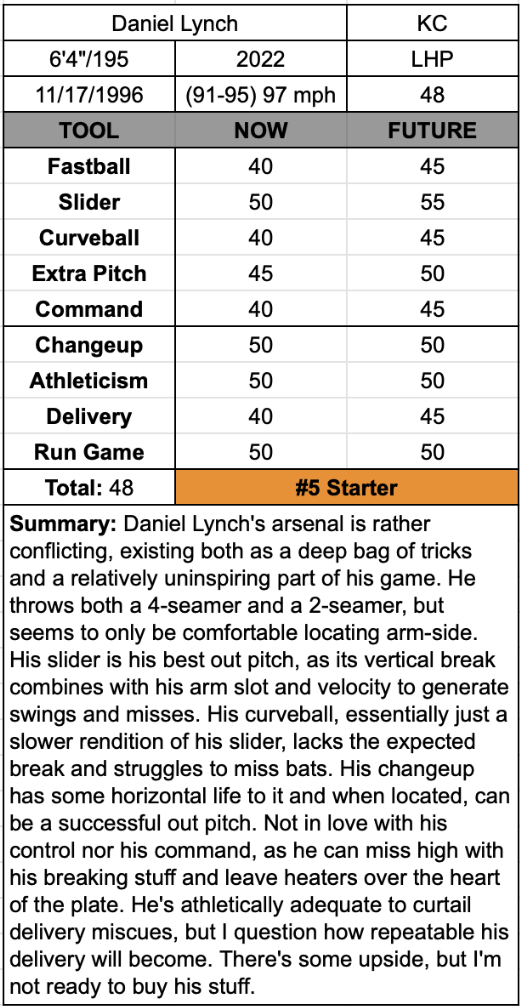
I like his slider a good bit and it’s a pitch that can generate strikeouts, though Lynch will hang it from time to time. He misses over the plate often, both with his fastballs and his off-speed pitches. Despite great velocity, he doesn’t miss enough bats for me to be comfortable anointing him. It’s possible his command or other pitches take an unexpected step forward, but for now, his median remains far below his ceiling.
7. Alec Marsh, Starting Pitcher, 48
A lower-profile prospect that I’m higher on is former Arizona State Sun Devil, Alec Marsh. From his explosive delivery to his steady, yet intense, demeanor, Marsh has the mental attributes that draw comparisons to Max Scherzer. His stuff is just a step above pedestrian, however his athletic profile and strong delivery help brew some considerable upside, something I’m more willing to bet on than Lynch. I don’t love his current arsenal, but his game remains difficult to bet against.
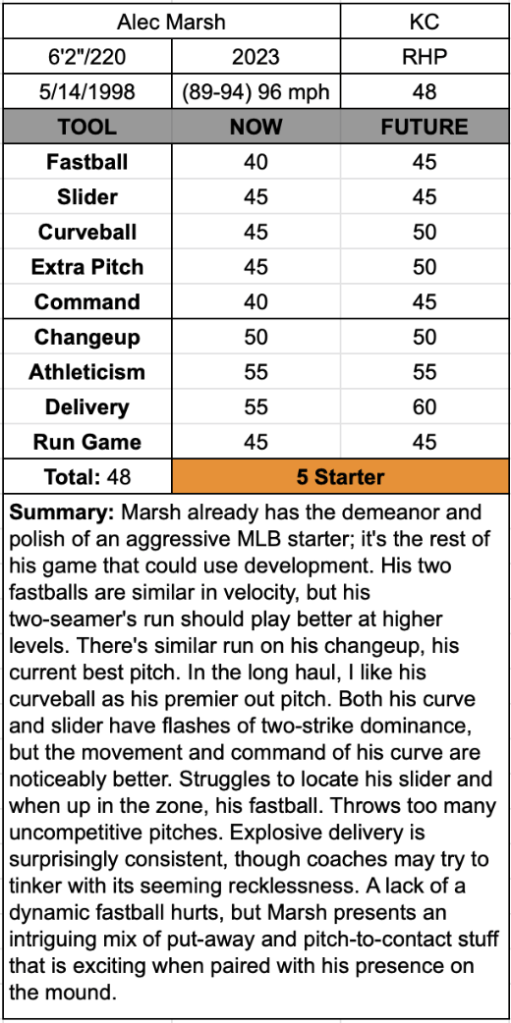
Sporting two fastballs, two breaking balls, and a changeup, Marsh doesn’t lack tools by any means. He’ll sit in the low-90s with both fastballs, though the movement on his two-seamer presents itself as a weapon against batters in both boxes. Both breaking pitches have confounded opponents, though his curveball is the only one worth writing home about. His changeup is consistent with his two-seamer in terms of movement. As stated above, his mix of swing-and-miss and weak-contact-inducing stuff is intriguing at worst and a recipe for success at best.
6. Carlos Hernández, Relief Pitcher, 49
Carlos Hernández is certainly fun to watch, at least for most fanbases. For Kansas City fans, stressful may be a more accurate term. That isn’t to say he is particularly bad; his ranking would say otherwise. He just happens to have abysmal command and a concerning delivery to patch up. On a positive note, other aspects of his game are trending in the right direction.
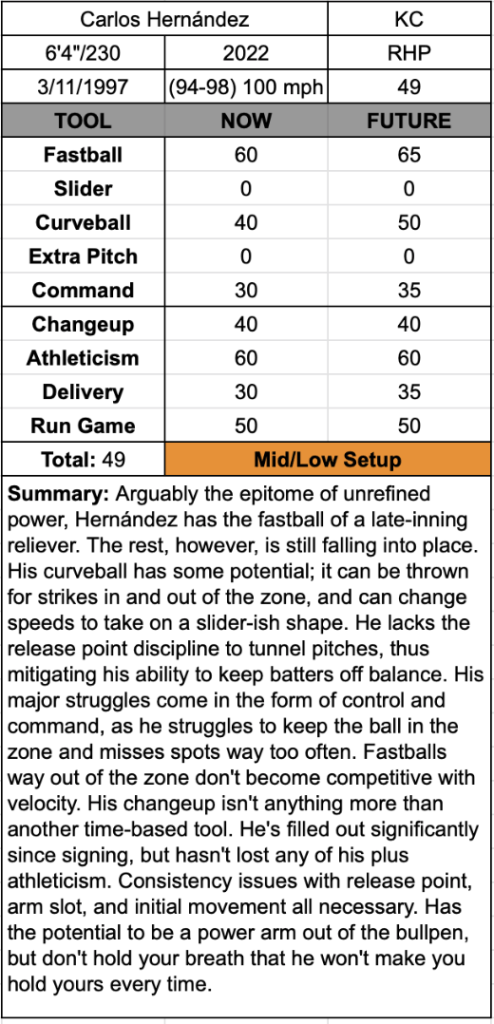
Hernández’s game is unsurprisingly predicated upon his plus-plus fastball. He’s a stereotypical power arm if I’ve ever seen one. Since signing in 2016, Hernández has gained tens of pounds of muscle while retaining his above-average athleticism, a feat that should not be overlooked. His changeup won’t wow many, but it doesn’t have to, given the rest of his arsenal. His curveball projects as a versatile second pitch that complements his fastball quite well. The delivery issues are incredibly apparent, but if he can hit his spots at a competent rate, the Royals will have a solid fireballer in their bullpen.
5. Ben Hernandez, Starting Pitcher, 51
The second Hernandez Kansas City has to offer, the youngest player on this list garners excitement for a handful of reasons. First and foremost, his circle-changeup is Major League-ready. His slider is comparable to others’ curveballs, with a massive speed differential and strong vertical movement. He’s a decent athlete and just turned 19. He may be a few years away, but the ceiling is admirable and the median is already high.
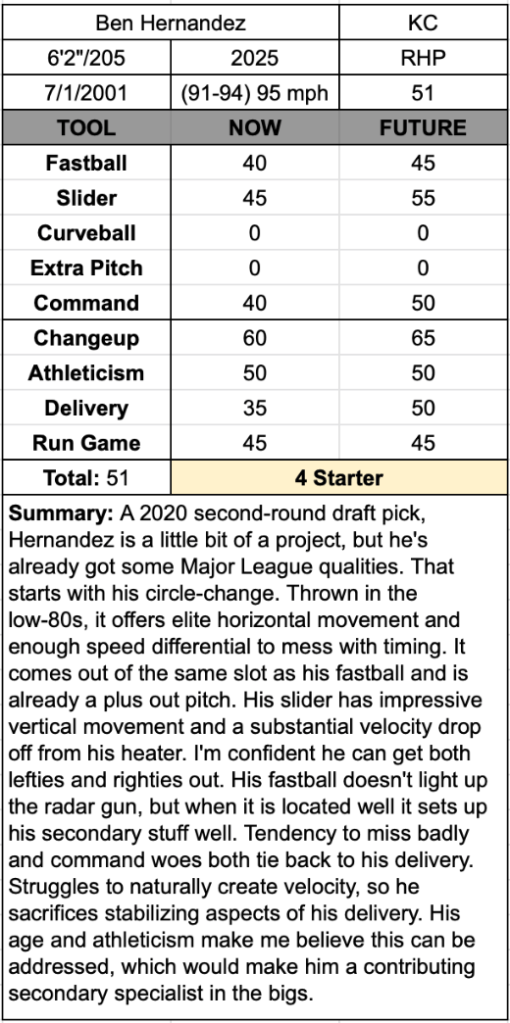
Considering his age, it shouldn’t come as a surprise that Hernandez sits in the low-90s. His current delivery exemplifies that, as he sacrifices command for manufactured velocity. Thus, he’ll have some major misses to add to slight inconsistencies in his command. Age and athleticism are two important advantages to have at this stage of his career, and I’m confident he’ll have the time to flesh out a better deliver. Improved command and velocity could create a Luis Castillo clone.
4. Kris Bubic, Starting Pitcher, 54
An up-and-down start to his career shouldn’t make Royals fans abandon their high expectations. He’s a young pitcher in a season predisposed to stress, and he hasn’t been disastrous. What should worry them is his treacherous delivery. Sure, it’s deceptive, and it’s gotten him this far, but his elbow must be begging him to make a change. Plus, it plays to serious command concerns that limit his upside. His release point and arm slot are yet to be consistent, and he leaves slow stuff up in the zone at a high clip. Bubic is rightfully terrifying, but his stuff may be special.
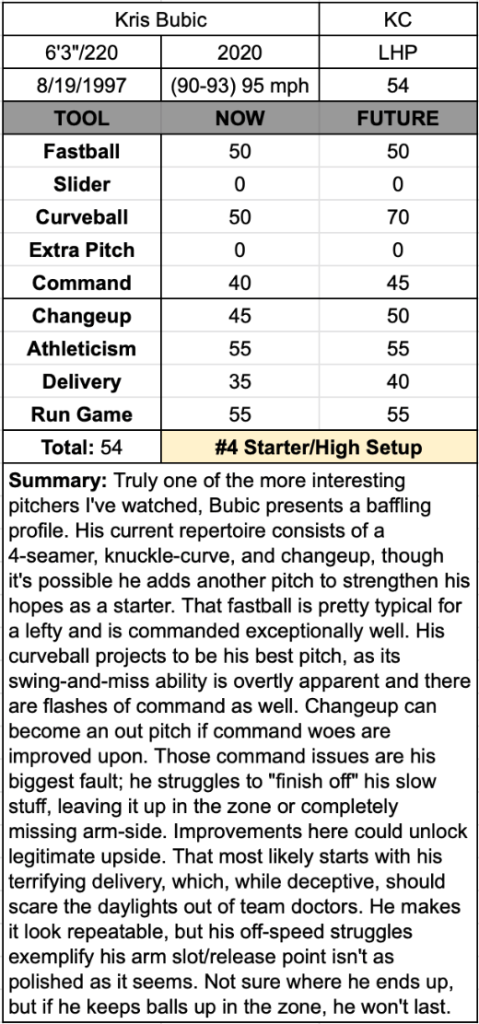
His fastball has strong velocity for a southpaw and is consistently located well. Bubic’s best pitch is his knuckle-curve, a pitch that at its best is one of the best in the sport. The command woes cloud that projection, but his ability to rack up strikeouts with it is incredibly fun to watch. As his command, I expect his changeup to see a similar trend. The upside is very real, but medical and mechanical concerns suppress his projection.
3. Jackson Kowar, Starting Pitcher, 55
Kowar is another name that I’m slightly higher on, though that may be a result of others not meeting expectations. Kowar is a comfortable projection to be a middle of the rotation starter, though that’s likely also his ceiling. His fastball is fine, yet the worst of three pitches. He possesses a strong curveball that has both freezes and whiffs on its record. His changeup has some run to it and is an adequate weapon versus left-handed hitters.
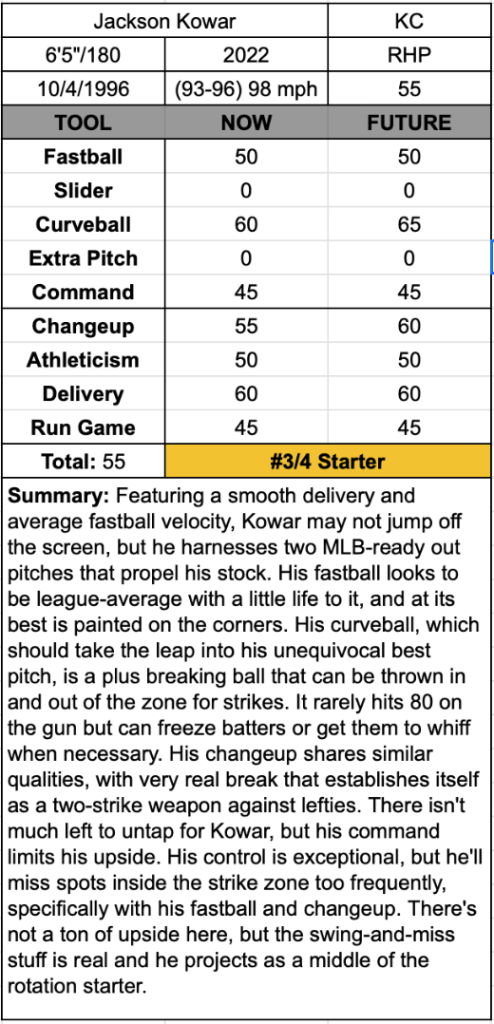
What dampens his game is his lack of command. His control is immaculate, leaving all of his misses in the strike zone. He’s got a smooth release that likely won’t be tinkered with and league-average athleticism. Kowar’s game is essentially set in stone, but he’s ready to get professional hitters out at a decent rate.
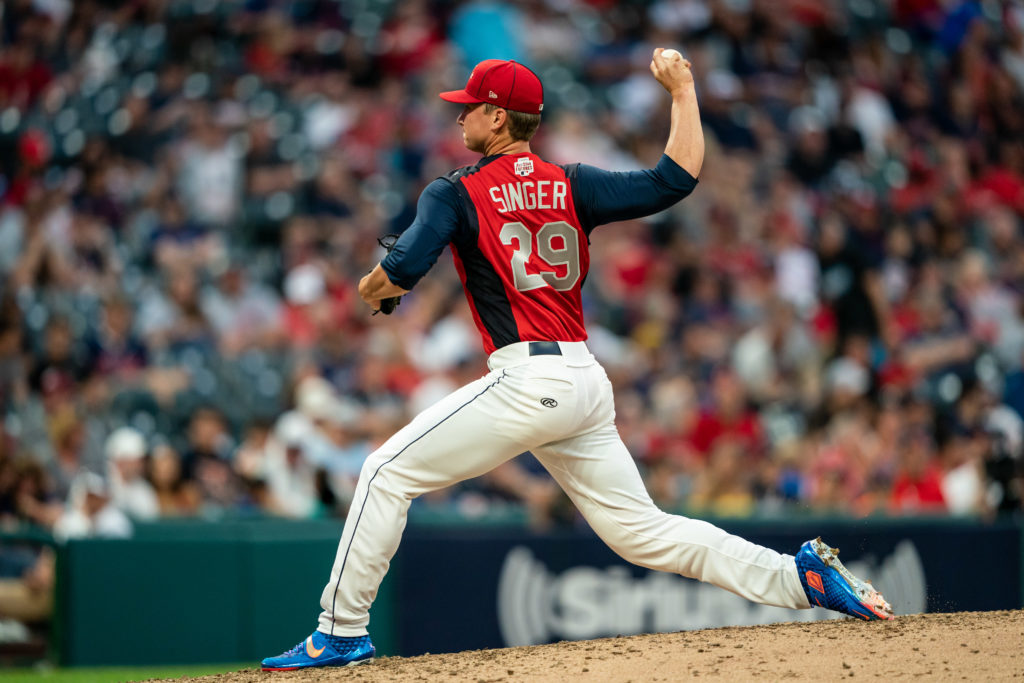
2. Brady Singer, Starting Pitcher, 58
Singer has been solid outside of two outings and is currently cruising off of a wave of preseason hype. That hype is well-deserved when considering his arsenal. He uses a two-seamer to set up his developing changeup and plus slider. Said slider possesses substantial break at 85 mph and is clearly his best pitch. His East to West style of pitching is almost unique in today’s game, but he makes it work against both lefties and righties.
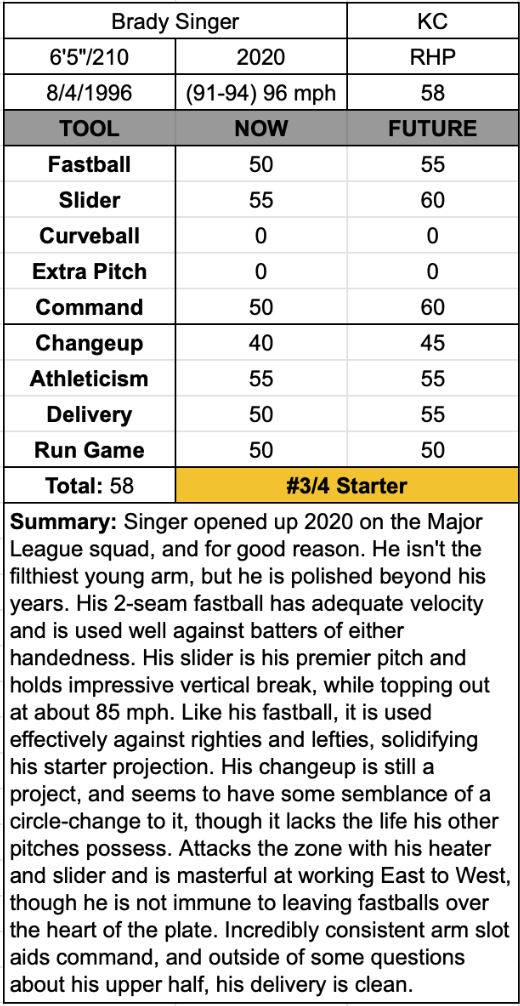
He’ll miss inside the zone a little bit, but there are minimal concerns regarding the long-term quality of Singer’s command. His ability to consistently deliver various pitches from the same release point is a huge aid to his game and something that puts him above other prospects of his age. Singer has the upside of a second starter, but his pitch-to-contact approach and uninspiring fastball ultimately limit his projection to that of a middle of the rotation starter, but that doesn’t mean he can’t be a meaningful contributor.
1. Asa Lacy, Starting Pitcher, 61
In a rather predictable turn of events, the Royals’ most recent first-round selection is the best young arm the system has to offer. His fastball has elite velocity for a lefty, and there’s still room for him to grow. If his average fastball ends up sitting at 96, nobody should be surprised. Add that to good extension from his 6’4″ frame and batters are sure to be left in the dust. Oh, it also has some run to it.
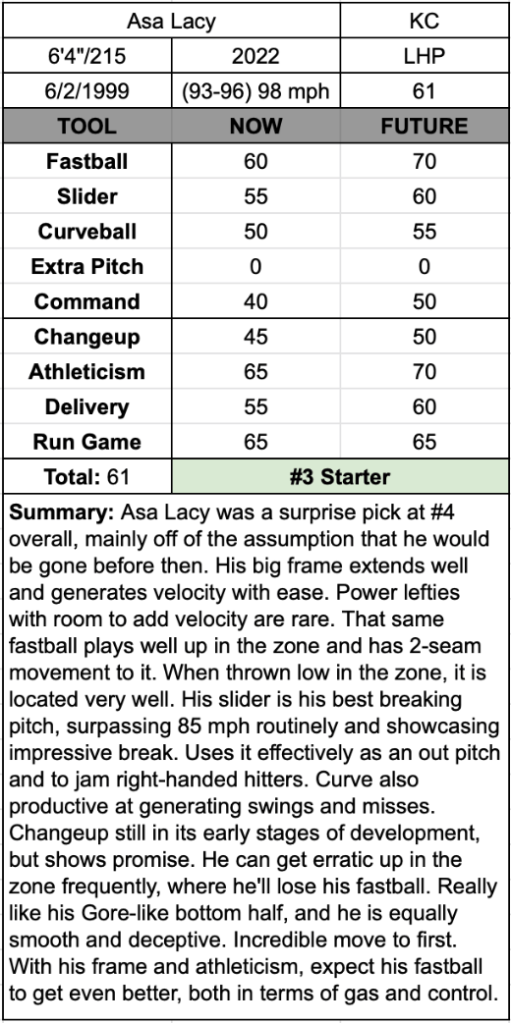
His other pitches aren’t equally dominant, but certainly provide promise. His back foot slider is an out pitch against both righties and lefties, and his curveball finishes off lefties well. His changeup is not refined just yet, but projects to be average. His delivery draws comparisons to the highly-touted MacKenzie Gore, though he’s not immune to spells of poor command. This happens more frequently with his fastball than anything else, but he has legitimate struggles locating up in the zone. All in all, Lacy projects as a strong third starter, but further development of his command and secondary pitches could make him an ace.
Overall, there’s a lot to like with Kansas City’s farm system. The bullpen will receive quality arms sooner rather than later, with power arms and versatile assets waiting in the wings. A plethora of young starters will see the mound in coming seasons, and while they may be a tad overhyped, they present the Royals with dastardly upside and a whole lot of fun.
If you have any comments, questions, or concerns, feel free to reach out to @ALiccScouting on Twitter. Don’t forget to check out the rest of Front Door Fastballs and check back for more. Thanks for reading.
 frontdoorfastballs.com