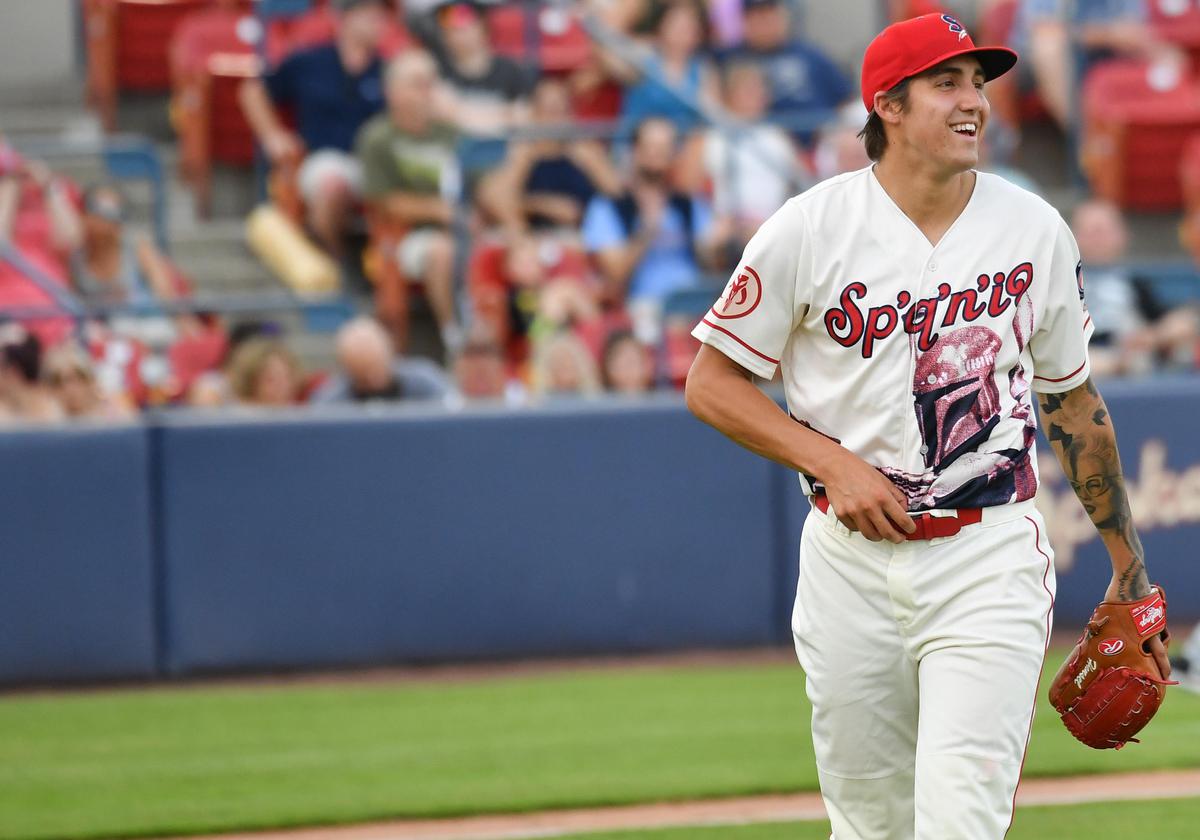
The first of its kind on Front-Door Fastballs, the Texas Rangers Pitching Prospect Primer will dive into Texas’ farm system in an effort to scout their young arms. This project will hopefully expand to all 30 MLB teams, creating a coherent compilation of rankings and projections.
Before diving into the intriguing prospects this organization has to offer, I’d like to offer a brief explanation on this process. For the team at hand, each of their top-ten consensus pitching prospects will be scouted, given that their is tape available (For example, Ricky Vanasco would’ve made this particular piece if any tape was available). From there, a scouting report will be done on each one, the template for which is below. Next to the “total” section will be a projection based on one’s grade, again pictured below.
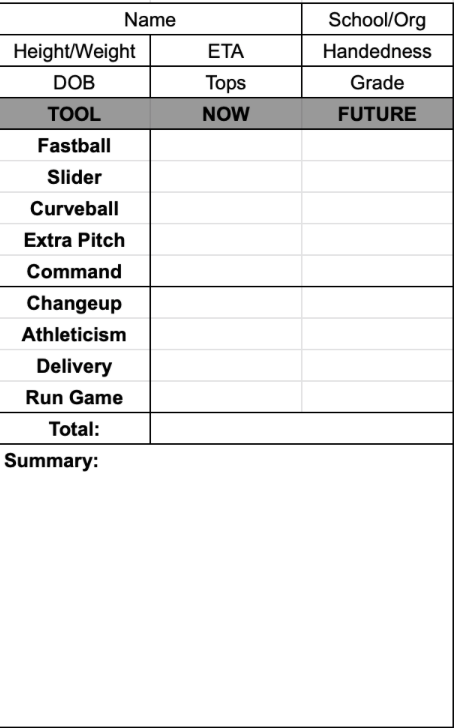
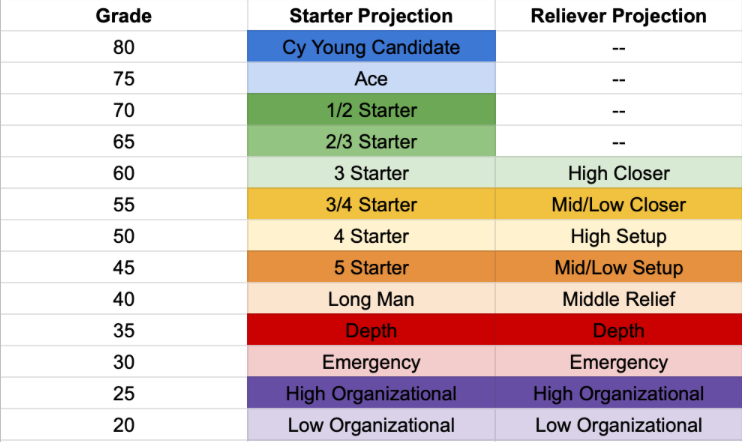
As for how these grades will be calculated, each of the nine traits will be scored on the typical 20-80 scale, where 50 is Major League average. In the top group of traits, an average will be taken of each future grade, and rounded down to the nearest whole number. This makes up a significant portion of the entire grade. The future grades for the bottom group of traits act as a means of adjustment, where traits of at least 60 add one point to the grade, and traits equal and under 40 take away a point. The total is then taken and given its projection. At the end of each primer will be an updated big board.
With that out of the way, let’s dive into the Texas Rangers’ pitching prospects.
10. Tyler Phillips, Starting Pitcher, 44
The tenth-best pitching prospect in the Rangers’ organization, Phillips projects as a spot starter. His arsenal is deep, but does not currently possess put-away stuff against professional hitters. Phillips’ knuckle-curve is his best pitch and poses a real swing-and-miss threat to right-handed hitters, the only one of his pitches to do so. The duality of his heaters also inspires optimism, as it allows him to play both up and down in the zone.
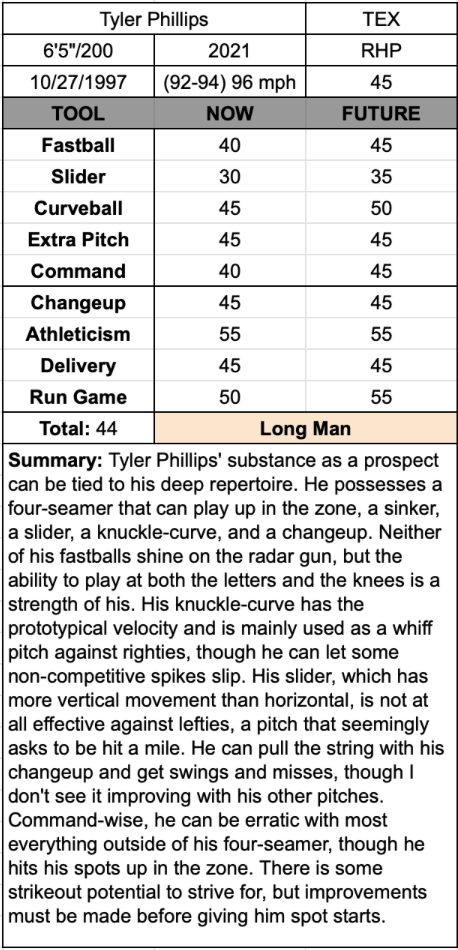
For someone who seems to pitch to contact, Phillips’ control will have to take steps forward in order to avoid high power metrics. He’ll let non-competitive pitches fly below the zone with concerning frequency, and isn’t a dazzling example of command inside the zone either. Ideally, he plays to the strengths of his arsenal so he can feature his knuckle-curve and progress into an adequate spot starter or long man. For now, though, there are serious concerns about his ceiling.
9. Demarcus Evans, Relief Pitcher, 44
Despite his low grade, Evans’ game is not without things to like. His size is helpful to his velocity at worst, and horrifyingly intimidating at best. His fastball isn’t spectacular, but Evans is far from lacking in the arm strength department. Having only two pitches to his name relegates him to a reliever status. Unfortunately, neither of those pitches rise above the Major League average.

Evans’ struggles with command are pronounced, hurting him with both walks and hard contact. Without elite stuff or great athleticism to adjust mechanics, I question his ability to develop into a quality reliever. His current delivery stresses his arm, and while it may have not cost him yet, it’s something to watch moving forward. Evans is currently on the Rangers’ 60-man player pool, playing into his 2020 ETA, but Texas should be wary to give him opportunities so soon.
8. Cole Winn, Starting Pitcher, 48
The first surprise on this list is Cole Winn who is generally known as one of the Rangers’ top prospects. Via MLB Pipeline, Winn is their 4th-best prospect and their best young pitcher. FanGraphs ranks Winn as Texas’ 7th-best prospect, the second pitcher to only Yerry Rodriguez. There’s certainly a lot of upside to his game, something a 96 mph fastball, a plus curveball, and above-average athleticism bring to the table.

As the report states, Winn’s inability to consistently hit his spots casts a shadow over the rest of his game. His curveball is a legitimate MLB pitch, but everything else is all over the place. Walking more than five batters per nine innings simply isn’t going to cut it as the California kid climbs up minor league ranks. His biggest enemy is himself, and without significant improvements in this area, he shouldn’t see Major League action.
7. A.J. Alexy, Starting Pitcher, 51
There’s a lot to like about A.J. Alexy’s profile. He’s got three MLB-ready pitches, all of which he can use effectively to generate swings and misses. His fastball has an intriguing velocity/movement combination that plays well low in the zone. Off of it plays his changeup, which, when located, is dangerous. Additionally, his curveball remains effective both early in the count and late, as he can drop it in for strikes and drop it below the zone.
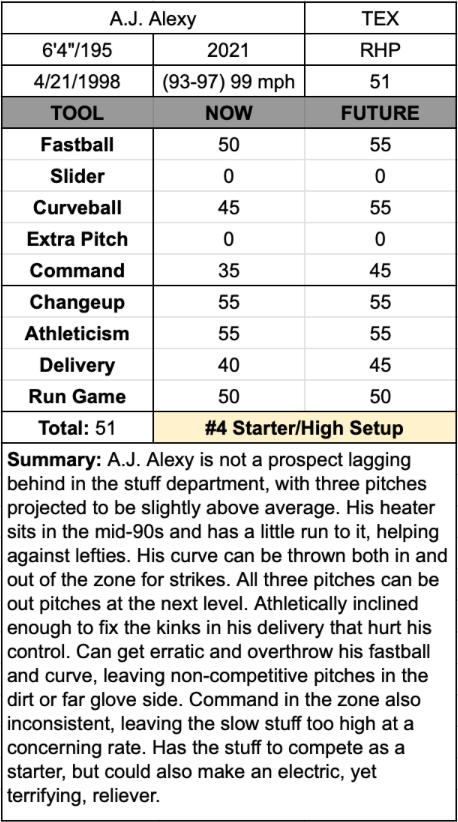
Like Winn, the biggest drawback of his game is his lack of control. This sprouts from detrimental quirks in his delivery. Thankfully, he is athletic to a point where most of his mechanical flaws are pretty fixable. That isn’t to say that Winn is not athletic, but I’m afraid Winn may need an entire rebuilding of his delivery. Whether it be in the back half of a rotation, stretched out in the bullpen, or coming in during the later innings, Alexy projects as a relatively promising pitching prospect with room to grow.
6. Yerry Rodriguez, Starting Pitcher, 52
Simply put, Yerry Rodriguez knows how to pitch. His tools are strikingly average, but his feel and makeup help build the intangible side of a professional pitcher. Ideally, he’d garner more extension on his smooth delivery to help his stuff. It’s understandable why he’s ranked highly (20th via MLB Pipeline, 1st via FanGraphs) and I think he comfortably projects as a consistent starter. I’m less bullish on his ceiling but can’t blame anyone for taking a more optimistic approach.
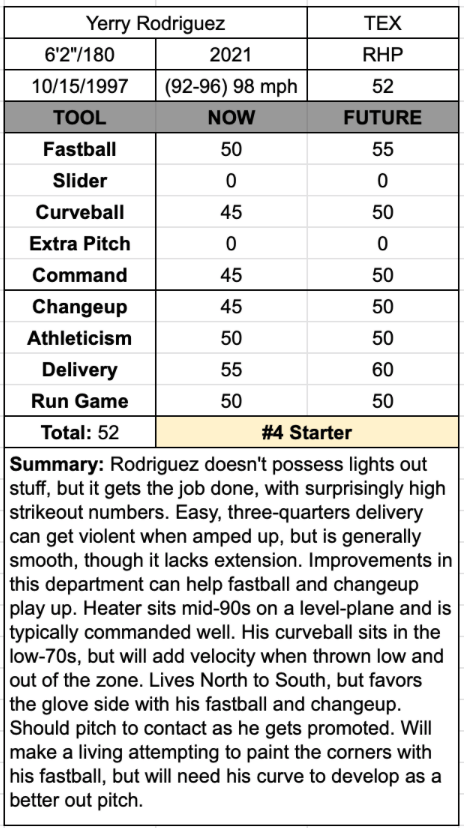
Not having a fourth pitch hurts Rodriguez more than most prospects. The distinct speed differential from his fastball to his off-speed pitches is helpful when his release point is down pat, but any slight miscue can act as a deadly tell. He’ll earn his pay living in the “shadow zone,” especially if his command continues to improve. Other than that, further development of his curve remains the most pressing order of business. Rodriguez is ready for the bigs, even if he won’t take the league by storm.
5. Joe Palumbo, Starting Pitcher, 52
With Rodriguez and Palumbo gathering the same grade, it merely came down to the latter’s (proven) MLB-readiness that puts him ahead. He gave up three runs in two innings of work against the Colorado Rockies over the weekend, but still flashed competence. Not dissimilar to multiple prospects on this list, I have serious questions about Palumbo’s upside. His fastball will never eclipse average and he lacks upper-level athleticism, making adjustments that much more difficult. His lack of put-away stuff, along with his surplus of stamina (shown at the minor league level) lends itself to a starting pitcher projection.
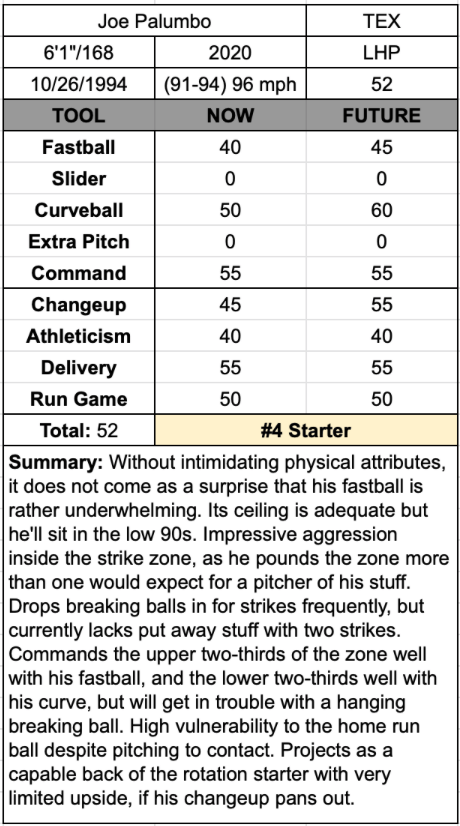
Palumbo unequivocally attacks the strike zone, relying on weak contact and balance-based strikeouts to get through innings. This is exemplified through the use of his curveball, his one plus pitch. He frequently throws it in the zone for strikes, though it won’t generate the whiffs other breaking pitches will. There are valid fears about the long ball that must be confronted, but if his changeup develops there’s a solid chance Palumbo sticks around in the back half of a rotation.
4. Jonathan Hernández, Relief Pitcher, 53
A tick above the last two prospects, Hernández provides both upside and experience at the Major League level. Known for his velocity, Hernández is a name many Texas fans have already tied to the bullpen, a development I agree with. He’s looked good through two appearances this year, a relief (no pun intended) after his 5.61 FIP in 2019 (16.2 innings). Outside of his fastball, the rest of his pitches project to be average, but one can diminish the effects of a poor breaking ball with triple digits on the radar gun.
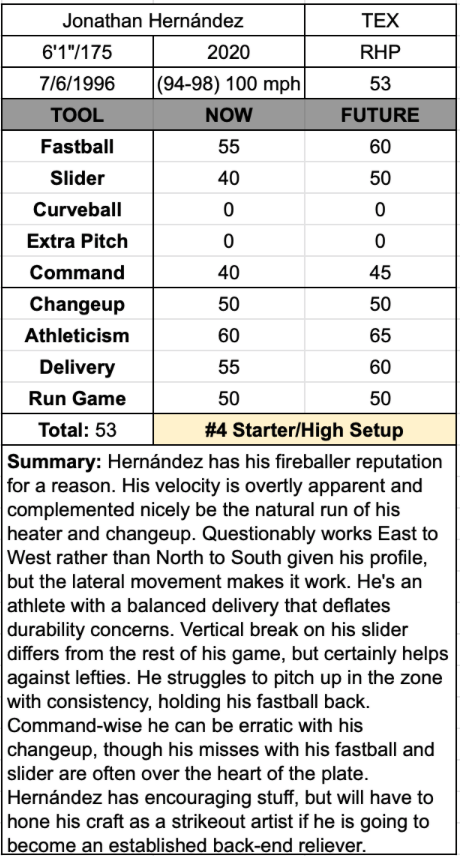
There is still room to grow for Hernández, who sports a very good delivery. His athleticism is certainly adequate to make any adjustment asked of him. Interestingly enough, both his fastball and his changeup move horizontally, which is preternatural given his velocity, but provides an added boost to his game. He’s yet to master the art of the strikeout and completely command his pitches, but Rangers fans should be excited about his arm out of the bullpen.
3. Ronny Henriquez, Relief Pitcher, 54
Ronny Henriquez is as exciting as he is little. And he is very little. The 155-pound pitcher has already gained significant velocity since his original signing, and there’s more development to come with the rest of his game. For now, he utilizes an average fastball that he locates well, along with a nasty changeup and a slider that is worrisome, but helps keep hitters off-balance. The best is yet to come for Henriquez.
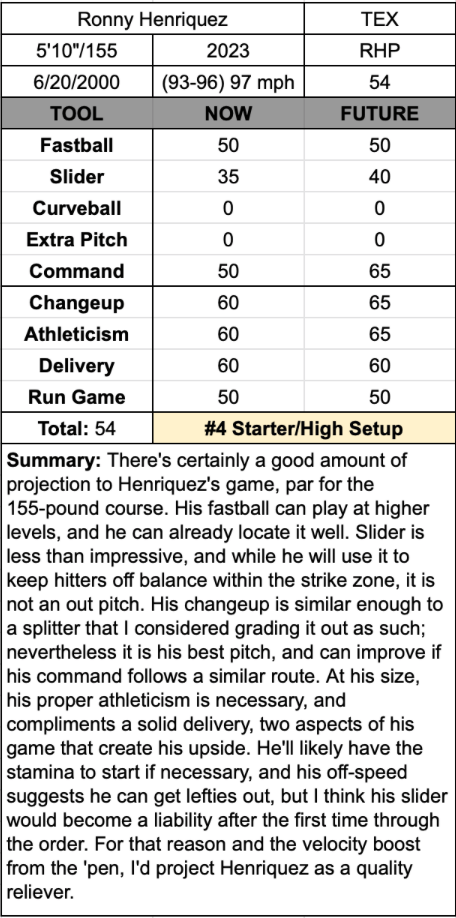
That aforementioned claim is backed up by very good athleticism and a clean delivery. He throws harder than his size would suggest, but he is also quite malleable. For that reason, his command should see incredible jumps as we move forward. An already dangerous changeup resembles a split-fingered fastball and acts as an out pitch in ways his slider does not, helping to forge that upside. He’ll have his doubters, but consider me in on Henriquez.
2. Hans Crouse, Relief Pitcher, 55
This is probably the biggest surprise of this primer. Crouse is highly-touted for a reason. The former second-round selection has exciting stuff, pitched well through injuries, and has arguably the most potential in the organization. Currently a starting pitcher, there’s a very strong argument to keep him there, especially given the state of the organization. However, I feel his stuff can be dynamic out of the bullpen, considering the inherent velocity boost and a de-emphasis on getting lefties out.
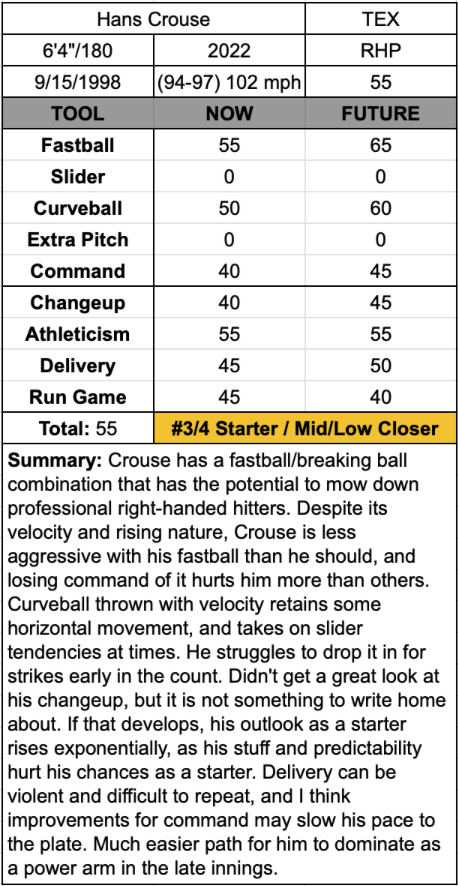
As his projection states, I think Crouse could be a good starting pitcher. In order for that to happen, his changeup and command will both have to make noticeable strides. Situations that require explosive arms and harsh breaking balls suit Crouse well already, and the Rangers can benefit from grooming such potential into a closing role. The innings in which he pitches are still up for debate, so I’ll focus on what he needs to do as a whole. His curveball is a good out pitch, but needs to be thrown for strikes earlier in the count. Moreover, his fastball has real potential, but he still looks to paint the outside corner with it, rather than intimidating righties up and in. There’s development left to be had, but Crouse is a dynamic pitching prospect with the makings of a dangerous Major Leaguer.
1. Owen White, Starting Pitcher, 56
MLB Pipeline did not rank Owen White in their top-30 prospects within Texas’ organization. FanGraphs placed him 23rd. It may be crass and it can certainly turn out to be wrong, but for my money, Owen White is the best pitching prospect the Rangers have to offer. White’s traits spell upper-level starter, even if his projection brings him down a peg or two. He’s an athlete with three solid pitches and a knack for slowing the run game. Injuries have so far derailed White, whose fun is just beginning.
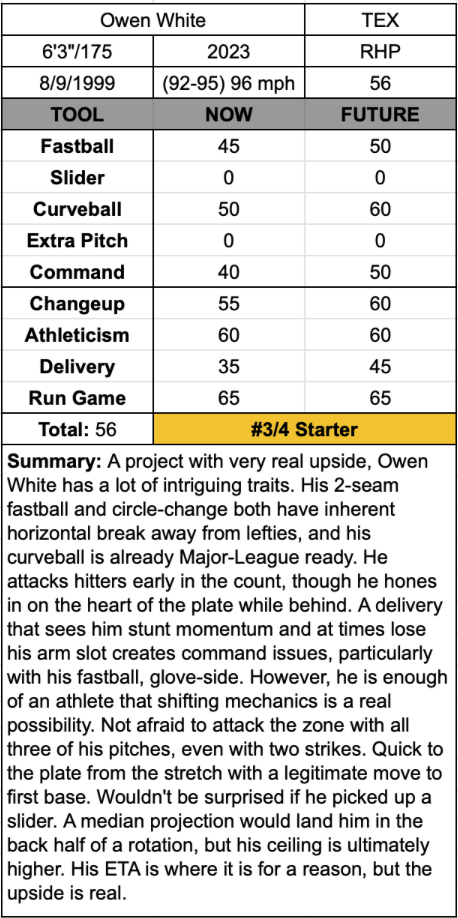
Health concerns and a raw delivery push White’s Major League arrival back a couple of years, though I’m confident he’ll develop into a high-level pitcher. His 2-seam fastball is his worst pitch, though its velocity and arm-side break are up to par with the big leaguers. White’s curve attacks the zone and plays off of his other pitches nicely. The best pitch in his arsenal could very well be his circle-change, which mirrors his fastball in terms of release point and movement, without the velocity. All of these project well enough to get MLB hitters out with regularity. As for his flaws, they currently lie in a mitigating delivery and a tendency to pitch scared while behind in the count. He’ll lose his arm slot and miss glove-side with his fastball, then leave something over the heart of the plate rather than risking a walk. The athleticism he possesses makes him malleable with his delivery, an innate quality that may erase these issues while also adding velocity. I’m banking on upside, but there’s a storm brewing down in Arlington, and a quality starting pitcher may be the result.

If you have any comments, questions, or concerns, feel free to reach out to @ALiccScouting on Twitter. Don’t forget to check out the rest of Front-Door Fastballs and check back for more. Thanks for reading.
 frontdoorfastballs.com
One thought on “Texas Rangers Pitching Prospect Primer”