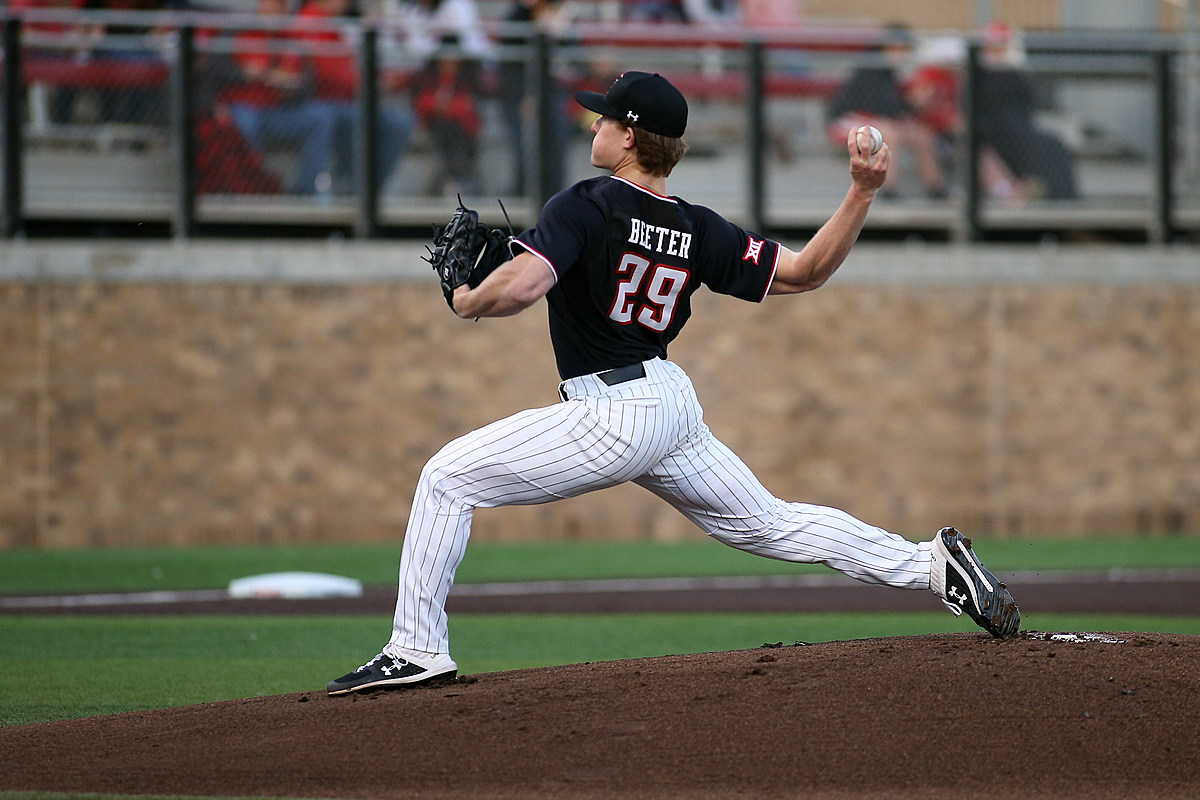
On Thursday, June 11th, the Los Angeles Dodgers used the 66th pick, a competitive balance selection from the Kenta Made trade, on Clayton Beeter. Hailing from Texas Tech University, Beeter at face value is one of the four right-handed pitchers the Dodgers selected in the 2020 MLB Draft. He may not have the name recognition of Spencer Torkelson or Asa Lacy, but Beeter’s profile may be the most fascinating in his class.
His story starts in Lubbock, where Perfect Game’s 500th-ranked recruit was forced to endure Tommy John Surgery during his first semester on campus. This late-2017 surgery forced Beeter to miss the following college baseball season, an injury that was only compounded by arthroscopic surgery on the same elbow in the summer of 2018.
In an effort to slowly increase Beeter’s workload, Texas Tech started him out as a late-inning reliever. Pitching in 21 games, he logged 20.2 innings, 8 saves, a 3.48 ERA, and a 19.4 K/9. His walk rate, which approached one per inning, was clearly the most debilitating aspect of his game. His stuff was apparent, but without the ability to throw strikes consistently, it ultimately wouldn’t matter much.

His age 21 season saw the Redshirt Sophomore land on the mound in earlier innings, starting games and eventually emerging as the school’s ace. The pandemic-shortened season meant that Beeter would only throw in four games, but noticeable improvements look to be arise. Beeter limited runs to the tune of a 2.14 ERA and maintained a high K/9, with a 14.1 mark. Most importantly, Beeter’s control skyrocketed, dropping his BB/9 from 8.7 to 1.7 and increasing his strikeout/walk ratio from 2 to 8.25.
This progress landed Beeter on draft boards across the country, coming it at #19 for FanGraphs, #22 for ESPN’s Kiley McDaniel, #24 for The Athletic’s Keith Law, and #51 for MLB Pipeline. His round one hype was the result of his malleable game and shockingly-low taxed arm. He landed in the second round, but he has the ceiling of a first-rounder and the floor of an undrafted free agent, something Beeter already has experience with after the 2017 MLB Draft.
His quick ascension has been remarkable, but that’s only the beginning of Clayton Beeter.
What are the Dodgers getting?
Beeter’s arsenal
It took more than a high strikeout rate for Beeter to climb up draft boards. Beeter possesses a repertoire that rivals anyone in this class. That starts with his 70/70 fastball, an MLB-ready pitch that tops out at 98 mph while sitting between 94 and 97 on the gun. Its high active spin gives it the often-envied “rising” action. His fastball is often used up in the zone, where it is at its best.
He complements his heater with two elite breaking balls. Beeter claims his curveball is his best pitch, and it is hard to disagree. It uses minimal active spin, a trait that helps cement his player comparisons, something we’ll get to later. In early count situations, his curve will drop in at around 80 mph, but he isn’t afraid to add velocity for more swing-and-miss action below the zone with two strikes. In my opinion, his harder curves are his best pitch.
Similar to his power curves, Beeter’s slider (a 70/70 pitch according to FanGraphs, rather than his 60/60 curve) sits at 85 mph. His fastball/slider/curveball combination is enough to effectively attack right-handed hitters, but taking on lefties typically minimizes slider usage. Beeter has been developing a changeup as well, something he noted in an interview with baseballprospectjournal.com.
“Everyone can improve their changeup movement,” Beeter said. “You see some big leaguers with some nasty movement where it looks like their changeup is just falling off the table. Everyone wants one like that. I think I have the speed difference, but I want to get more movement.”
Clayton Beeter, on the development of his changeup. Via Baseball Prospect Journal
Development here would be a significant hurdle for Beeter to clear, as the ability to break down left-handed hitters frequently separates right-handed starters from their bullpen counterparts.
Beeter’s mechanics
He’s known for his elite, MLB-ready stuff, but there’s certainly more to his game. Beeter possesses an overhand delivery, with a deceptive upper-half that helps him pitch tunnel effectively.
His command woes were, at least temporarily, addressed mechanically, though no major changes were made. Rather, a couple of minor kinks were cleaned up, leaving Beeter with an eerily similar delivery. The same deception exist, now with improved command.
Beeter’s delivery is repeatable, which is a positive, especially for a pitcher that has struggled with walks. There’s no violent, reckless motion to optimize velocity at the cost of consistency. He’s an easy thrower with the physical talent to effortlessly hit the upper-90s.
However, I am concerned with the angle of his throwing arm as he plants his front foot. He leaves a lot of room for his arm to “catch up” with the rest of his body, something that puts stress on the elbow. We’ve seen progressions like this inflict injury upon stars before, such as Stephen Strasburg. As the only issue with his delivery, it is not a life or death issue, just something to watch, especially for a pitcher that has already endured Tommy John.
His track record includes the same amount of elbow surgeries as recorded wins, so proving he can stay healthy may be something that makes or breaks his career. Recent signs provide optimism, but the lack of long-term production won’t give him the benefit of the doubt; at least for now.
The big question (and player comparisons)
Will he continue to start, or will he return to the bullpen?
Los Angeles’ vice president of amateur scouting, Billy Gasparino, was asked this question shortly after the MLB Draft. When asked what Beeter’s role will be, Gasparino said, “I know Beeter’s probably the one most people have doubt on, but we’re very bullish on his starting chances. If you had to pick one [of their four newly-drafted pitchers to relieve], it would be Beeter. With his breaking ball, which was the best in the draft class, we would be happy if he ended up in the bullpen. We think he’d be dominant there.”
That doesn’t exactly clear anything up.
Currently, Beeter’s lack of workload would be a reason to continue developing him as a starter. Without the risk of taxing his arm too much, it makes sense to bet on his starting-pitching upside, which might as well be the sky. His FanGraphs’ Future Value, a metric I cited when breaking down San Diego Padres’ prospects, is currently at 45, which is emblematic of a back-half of the rotation starter. That projection muddies the decision, and would point to a move to the bullpen.
If he struggles to develop his changeup, moving to the back-end of the bullpen becomes much more likely. A power arm with an elite breaking ball is a recipe for success in the late innings. Using the bullpen as a way to help mitigate Beeter’s weaknesses may seem counterproductive to his development, but it provides the easiest path to effectiveness at the Major League level.
Additionally, another reason for a move to the bullpen would be the reemergence of his aforementioned durability concerns. If starting long-term is too much for his arm, relief opportunities are the next step in his development.
The last reason the Dodgers may move Beeter to the bullpen is simply a matter of circumstance. Clayton Kershaw is under contract until the end of next season, and Los Angeles would be hard-pressed to let the future hall of famer walk. Walker Buehler and David Price round out the top half of a great rotation. Dustin May and Tony Gonsolin are highly-touted starters who will beat Beeter to the bigs. Josiah Gray and Brusdar Graterol are additional starters ahead of Beeter, throw Graterol is a perfect candidate for late-inning relief. This is without mentioning Alex Wood, Julio Urías, and Ross Stripling, who will all be starting this year for the Dodgers. Los Angeles is talented and deep. Even if Beeter develops as a starter, there’s no guarantee he gets a rotation spot for years to come.
I promised player comparisons earlier, so it’s time to fulfill that promise. If he sticks to the bullpen, we are likely to find ourselves watching a carbon copy of Nick Anderson. The Tampa Bay Rays reliever has a similar arsenal, relying on a deadly curveball and good fastball. Both pitches, in terms of spin and velocity, mirror Beeter’s.
Those same measurements can be found in Miami Marlin’s starter, José Ureña. Ureña throws a sinking fastball, instead of a “rising” one like Beeter, but their breaking balls are exceedingly similar. He also possesses an adequate changeup, something we’ll see in Beeter if he starts at the Major League level. It is important to note that performance is not factored in to player comparisons, as they are made almost entirely on a stylistic basis.
What’s next?
Furthermore, it’s apparent Beeter has MLB-level stuff. He’s improved his command and in the right environment, could see himself on the fast track to the bigs. Just how fast can Beeter rise?
Well, part of that answer lies in the idiosyncrasies that this season will bring. 60-man player pools and taxi squads are helpful for a league that faces new levels of uncertainty, but it also benefits some prospects. Despite being drafted about six weeks before the season opener, there are rumblings of Beeter making his major-league debut in 2020.
Now, a 60-man player pool is just that, a pool. There’s not yet an indication that Beeter will see the bigs in the same year he was drafted, but it remains a not-so-impossible possibility. In an unprecedented season, we are sure to see some unprecedented moves, and Beeter could be one of those. He’s an older prospect who should be able to get professional hitters out with his current arsenal.
His injury history may increase his chances of seeing Major League Baseball sooner rather than later. There’s a growing tendency to call up young pitchers, as the risk for injury is as prevalent as ever. Pitchers have shorter lifespans than we tend to remember, so capitalizing on their production before it’s too late has become a focal point of player development across the league.
We don’t know how much longer Beeter will last as a top pitching prospect. His elite stuff and command development could lead to a decade-long career. Just as easily, however, his injuries and command woes could make him another flare out in the minor leagues. If the Dodgers feel the need to capture his production in its current state, we very well could see Beeter in that Dodger blue before fall’s end.
The most likely option seems to be middle relief at the big-league level, if not in 2020, then 2021. From there, he’ll face a similar fork in the road. He may be given opportunities to spot start and develop as a starter. If the rotation fills up, he can transition to a back-end reliever to set up Kenley Jansen.
Personally, I’d like to see Beeter starting as quickly as possible. If Graterol moves to the bullpen, a 2021 rotation of Kershaw, Buehler, Price, May, and Beeter is possible, though there are other pitchers in his way. His upside is simply too much to pass up on.
Wherever he ends up, and however he performs, his history, ascension, and talent means he’ll remain one of the most interesting profiles in baseball. It’s our job to sit back and watch it unfold.
 frontdoorfastballs.com
2 thoughts on “The Curious Case of Clayton Beeter”