A strong core, a talented roster, and an elite farm system have helped solidify the San Diego Padres as a premier up-and-coming team. The imminent sprint may not grant them a playoff spot, but San Diego is ready to win some baseball games.
Even if their current ceiling is that of a persistent nuisance, nobody wants to play the Padres down the stretch. With a lineup headlined by Fernando Tatis Jr. and Manny Machado, it’s clear they won’t stay dormant for long. Defensively, the 11th ranked team in 2019 backs a pitching staff that plays host to Chris Paddack and Kirby Yates.
That same staff remains the biggest weakness of this San Diego squad. Emilio Pagán and Craig Stammen help create one of the better bullpens in the National League, but Paddack remains the lone top-end starter in the rotation. Garrett Richards, Zach Davies, Joey Lucchesi, and Dinelson Lamet offer competence, but not much more.
Returning back to the farm system, 2020 makes for a season that will stress each team’s minor league affiliates. The player pools are made up of low-level veterans and developmental prospects looking to aid the already-expanded rosters. Stronger farms not only benefit teams in the long run, but in the present as well. Major League-ready prospects can make or break their teams in a year where every game matters more.
Fortunately for San Diego, prospects are in surplus, and some are ready to help. Taylor Trammell may see some plate appearances late in the season, but bigger prospects loom.
The Padres’ pitching prospects have the potential to dominate, sooner rather than later.
A brief outlook
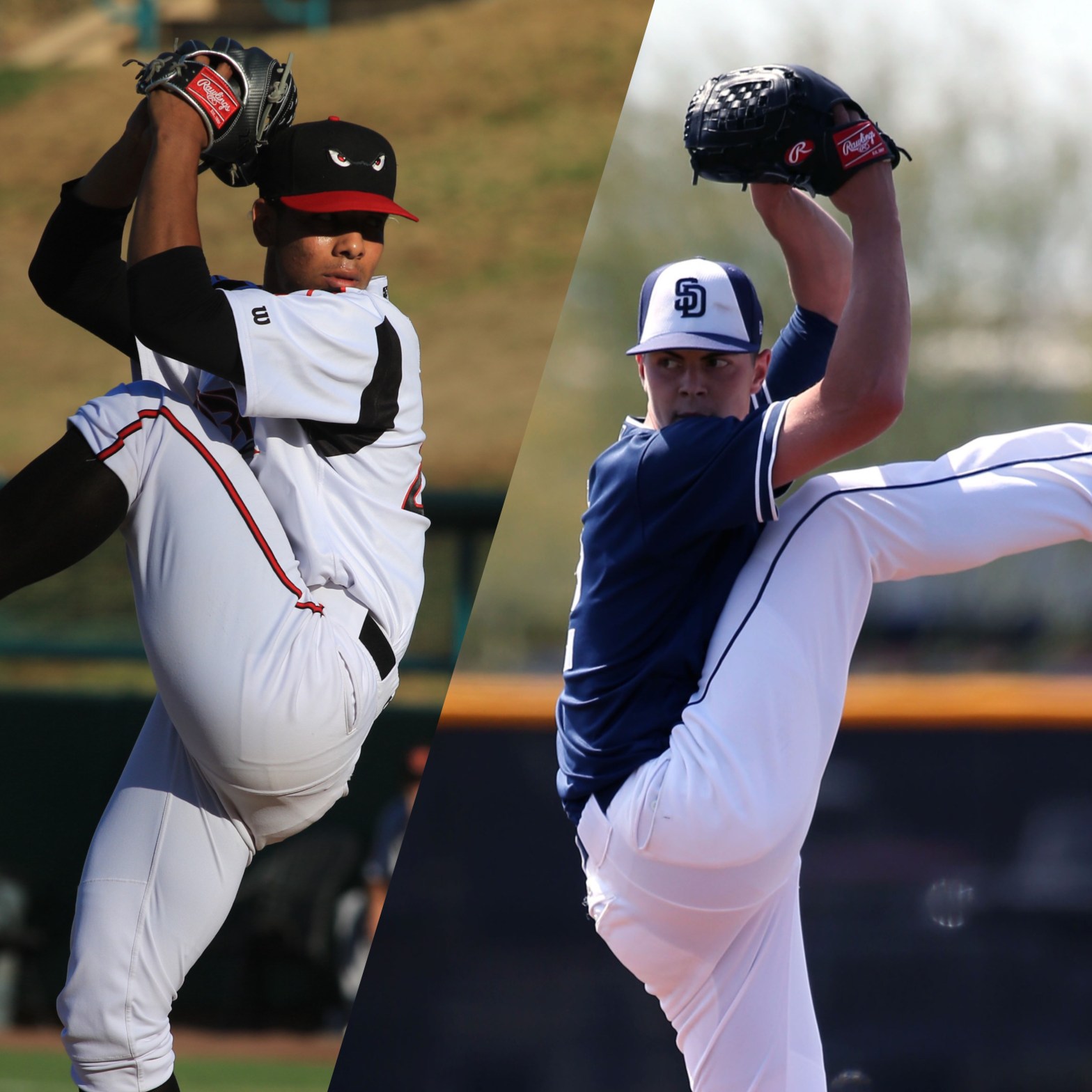
There is no doubting who tops the pile of prospects dreaming of Petco Park. MacKenzie Gore, the former 3rd overall pick (2017), is easily the Padres’ top arm. He’s also the third ranked prospect, nationally. Alongside him, literally, is Luis Patiño. The second-best pitching prospect San Diego holds has grown incredibly close with Gore. The two of them have risen at a seemingly identical pace. Both may contribute by this season’s end, even if 2021 is a more realistic estimated time of arrival.
Outside of those two, there are still additional reinforcements waiting. Adrian Morejon is a lefty with high-level stuff, but an injury history settles his projection to that of a starter, residing in the back half of a rotation. Michael Baez also has injury concerns, including back and shoulder incidents that have landed him in the bullpen. With adequate stamina but a lack of impact stuff, it’s likely he stays there. One pitcher that won’t be seeing the field in 2020, and possibly 2021, is Andrés Muñoz. Tommy John has taken away opportunities to play in the near future, though his return will be highly anticipated. A late-inning bullpen arm with an incredible fastball, Muñoz projects as an impact power arm.
Clearly, there’s an abundance of pitching talent waiting in the wings for San Diego. However, if the Padres compete for a title, it will come off the backs of Gore and Patiño.
MacKenzie Gore
The résumé is there, and so is the talent. His 70 Future Value (FV) is indicative of what’s to come, whether it be this year or next. FV is FanGraphs’ summation tool for prospects: a 20-80 scale meant to project a prospect’s first six years of service time.
His 6’3″, 195-pound frame is almost exaggerated by his deceptive delivery, which includes a high leg kick.
Thankfully, his throwing arm’s angle when his front foot lands is appropriately above 45°, exemplifying that his funky motion shouldn’t sacrifice his health. Still, a delivery that draws comparisons to Clayton Kershaw doesn’t mean much without the ability behind it. Gore’s got that covered.
According to scouting reports, Gore possesses an above-average fastball that shines in the active spin department. Off of that heater, peaking at 97 mph, he throws a strong curveball, which at its best is an impact out pitch. Gore can control his change up well, creating yet another deceptive aspect to his game. Lastly, his slider is still developing in terms of command, but scouts like its potential.
Statistically speaking, Gore has impressed in a similar manner. Throughout his minor league career, he’s sported a high K%, though his BB% has ranged from 6.9% to 8.9%. His command has dipped at times, but considering his K/9 never dipped below 10 at any level, he generates enough swings and misses to balance out these woes.

Another favorable metric for Gore is his xFIP marks. As his ERA fluctuates between untouchable and rocky, his xFIP stays steady, yet strong. He’s consistently pitched well, adding to his résumé at every stop. Even his career-worst HR/9 (1.25) is better than the likes of Kershaw, Shane Bieber, and Justin Verlander. Obviously, the league difficulties vary, but at his worst, Gore is still putting up acceptable numbers.

Taking a look at his rather friendly projections may help to illustrate a likely career path. The figures above show Gore retaining his consistency as a strikeout artist, while also improving his command. Such progress would cement Gore’s status as the top pitching prospect in baseball.
From his deceptive tendencies, to his tantalizing stuff, Gore’s upside is pretty clearly one of an ace. His FV is emblematic of a strong second starter. Whether he or Paddack takes the reins as the true top starter is not as important as the actual contributions Gore will make for San Diego. Those look to be sometime soon, as a unique 2020 will present the Padres with plenty of opportunities to give Gore the call. When they do, they’ll be one step closer to the postseason.
Luis Patiño
Patiño, the 20-year-old Columbian import, has quickly risen up the ranks of San Diego’s farm system since signing in 2016. The Padres’ second-ranked prospect is also FanGraphs’ 18th overall prospect. His 60 FV places him as an upper-level third starter with the capacity to hit 200 innings. Unlike Gore, who is most likely going to debut in 2021, Patiño is expected to get the call this season.
The righty and his six-foot frame are rightfully on the player pool for 2020. Many view this season as an opportunity for him to log some bullpen innings at the big league level, while making his name as a starter in the more-distant future.
His easy deliver has some similarities to his parter in crime’s, at least as far as leg kicks go. Patiño’s game revolves around his incredible athleticism, which helps him effortlessly sport a 65-level fastball that sits between 93 and 97 mph. He’s hit 99 on the gun before and will certainly again if coming out of the bullpen.
One of the more exciting things Patiño has to offer is his second-favorite pitch, his slider. While right now his slider looks to be average, to ignore its upside would be downright foolish. His slider’s 2500 RPM is adequate when combined with its impressive velocity.
At least for now, that seems to be the limit for Patiño’s upper-level pitches. He is working on a change up, and given the quick growth of his game, I wouldn’t count out its development; but for now, it isn’t anything special. The same can be said for his command, which has seen as many good days as it has bad. With the athleticism he possesses and a pretty smooth delivery, steps forward should be eagerly anticipated.
On a similar note, it is important to realize Patiño has only been pitching for a handful of years. In contrast to the lifelong pitchers that flood the minor league’s, Patiño presents himself as a canvas for the Padres’ coaching staff. The ability to be molded into virtually anything, due to his athleticism, cannot be understated. It draws comparisons to one Jacob deGrom, the best pitcher in baseball.
deGrom had only been pitching for five years before making his MLB debut in 2014. Sound familiar? This isn’t to say that Patiño will go on to win back-to-back Cy Young Awards or merely sniff the heights deGrom saw, but it is yet another reason to be excited. His natural velocity, athleticism, and time to grow create a perfect storm for Patiño, already one of baseball’s top pitching prospects, to blossom into a top-end starter.
As for his production, Patiño is just as potent as Gore, posting ERAs below 2.70 at every minor league level he’s visited. His K% has steadily increased from 8.44% to 11.74% in 2019. His BB% unsurprisingly hit 9.5% twice, though his stop with the most innings (A ball) saw a 7.3 BB%.
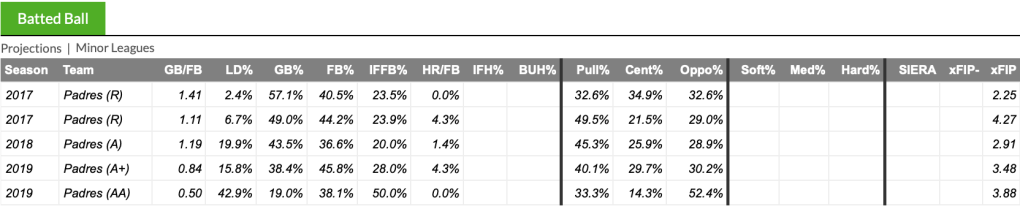
Furthermore, one of the most enticing aspects of his game come from his batted ball statistics. He’s clearly a fly ball pitcher, and that likely won’t change, but he’s been effective at limiting line drives. For someone that has had his struggles with command, his 4.3 HR/FB% at rookie ball and high-A are promising. Take into account his 1.4 HR/FB% at A ball and you’ll find an even more intriguing prospect.
His projections are less kind than Gore’s, as his strikeout rates are predicted to plateau while his walk rates stay high. Even so, his ability to limit home runs (and runs in general) should stay in tact, shown through projected ERAs of 3.91, 3.86, and 3.79 over the next three seasons.
If he does make his debut in 2020, the bullpen may be his home for a little longer than expected. He has kinks in his game that still need working out, or else they can be exposed when throwing expansive amounts of innings. Command that isn’t up to par typically doesn’t fare too well the second or third time around the order. The development of his change up could work wonders for his game, as it would properly adjust his approach against lefties. Without an impact change up, a fastball/slider combination can be eaten alive by opposing lefties. If he strengthens his game against left-handed hitters, his prospects as a starter brighten immensely. Hopefully, we get a chance to see these improvements in 2020.
A look forward
Between Gore, Patiño, and the aforementioned Morejon, Baez, and Muñoz, San Diego is building one hell of a pitching staff. The 2020 season may see some of these faces, but the truth is 2021 and beyond is what the Padres are building for.
The upside these prospects bring to the table should have the rest of the NL West terrified. A starting rotation of Paddack, Gore, Patiño, and some combination of Morejon, Lucchesi, and Lamet has the potential to go head-to-head with any in baseball. Facing a bullpen of Yates, Pagán, Baez, Muñoz, Drew Pomeranz, José Castillo, Matt Strahm, Stammen, and the leftover starter is almost as scary. Add that to the core of Tatis, Machado, Trammell, Francisco Mejia, and Tommy Pham, and the result is a playoff-bound team.
It may not be this year, but the Padres’ pitchers are coming. It’s only a matter of time before they’re dominating opponents in October.
 frontdoorfastballs.com
3 thoughts on “Watch out baseball, the Padres’ pitchers are coming”